

What Are the Uses of Air Blower? The Ultimate Industry Guide
Published/Updated: 2026 | Authority Guide for Industrial & Commercial Air Moving Applications
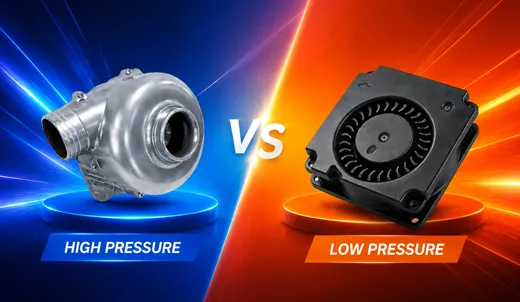
When procurement managers, mechanical engineers, and system integrators source air-moving equipment, they frequently encounter confusion among three distinct product categories: axial fans, air blowers, and air compressors. Standard axial fans provide high airflow volume but extremely low static pressure. Conversely, air compressors generate ultra-high pressure but deliver very low volumetric flow rates.
An air blower perfectly fills the technical void between a fan and a compressor. It delivers stable, medium-to-high static pressure along a directed path, making it an indispensable category of universal air-handling machinery across global industries. From miniature DC blower fans hidden inside household appliances to heavy-duty industrial centrifugal blowers running 24/7 in harsh factory environments, these machines drive critical manufacturing processes worldwide.
1. Fundamentals: What is an Air Blower and How Does It Work?
Before exploring the wide-ranging applications, it is essential to understand the engineering design of a standard industrial blower. This explains why blowers outperform conventional fans when operating against system resistance.
1.1 The Mechanical Definition
An air blower is a dynamic machine that converts electrical or mechanical energy into fluid kinetic energy to transport gas. The most prevalent commercial designs utilize a centrifugal structure. Inside a centrifugal blower, an electric motor drives an impeller lined with specially curved blades at high velocities. Air enters the housing axially through the intake center, turns 90 degrees, and is accelerated outward centrifugally into a volute casing before exiting the discharge port.
Unlike standard household or commercial fans that disperse air broadly in an open area, an air blower yields a highly concentrated, directional, and pressurized stream of air. This engineered pressure generation enables the airflow to overcome high system impedance caused by long duct networks, complex internal machinery, and dense filtration media.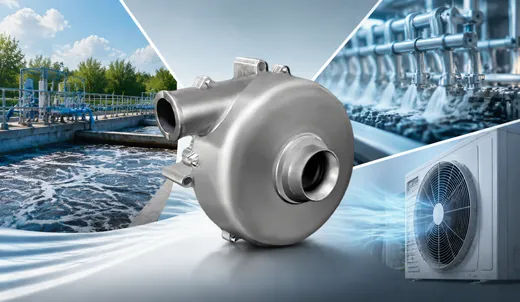
1.2 Technical Comparison: Fan vs. Blower vs. Compressor
Choosing the wrong equipment category leads to system inefficiency, motor burnout, or inadequate airflow. The table below details the performance characteristics across these three distinct technologies:
| Equipment Type | Pressure Rating | Air Volume Capacity | Primary Engineering Fit |
|---|---|---|---|
| Standard Fan (Axial/Propeller) | Extremely Low | Very High | Open-space air circulation, direct ventilation with zero airflow obstruction. |
| Air Blower (Centrifugal/Roots) | Medium to High | Moderate to High | Ducted systems, wastewater aeration, materials conveying, air filtration networks. |
| Air Compressor (Piston/Screw) | Ultra-High | Very Low | Pneumatic tool actuation, high-pressure storage cylinders, heavy industrial pressing. |
Rule of Thumb: If your air stream must travel through enclosed piping, intricate internal machine pathways, or multi-layer filters, an air blower is the correct engineering choice.
2. Core Applications: What Are the Uses of Air Blower?
Air blowers serve eight primary application sectors across industrial, commercial, agricultural, and residential landscapes.
2.1 Industrial Ventilation, Exhaust, and Dust Extraction
Industrial ventilation and exhaust systems account for over 40% of global industrial blower market demand. Manufacturing facilities—including metal fabrication shops, woodworking plants, cement factories, and chemical processing plants—consistently generate airborne dust, toxic fumes, particulate matter, and hazardous gases.
Standard fans lack the static pressure required to force contaminated air through long duct networks or dense fabric baghouses. Industrial centrifugal blowers maintain a powerful negative pressure within extraction hoods. This keeps dust from escaping into the facility, helps plants meet environmental air quality regulations, and protects workers. Specialized high-temperature blowers are also widely deployed in steel production and power plants to safely exhaust hot flue gases without component failure.
2.2 Wastewater Treatment and Sewage Aeration
In municipal sewage plants and industrial wastewater facilities, rotary lobe Roots blowers and high-pressure side-channel blowers are critical components. Their primary function is water tank aeration. These blowers pump compressed air deep into biological aeration tanks, releasing continuous streams of oxygen bubbles.
This steady oxygen supply maintains the life and activity of aerobic microorganisms. These microbes rapidly digest, break down, and neutralize organic waste matter, nitrogen, and phosphorus compounds. If the aeration blowers fail, the microbial colony dies, halting the purification process. Beyond aeration, blowers are also used for active sludge backwashing and fluid agitation within digestion tanks.
2.3 Pneumatic and Bulk Materials Conveying
Air blowers provide a clean alternative to mechanical conveyor belts for moving bulk powders, granules, and small ingredients through enclosed production lines. High-pressure blowers generate targeted air velocities within sealed pipe systems to move materials efficiently.
Common materials conveyed via blower systems include:
- Food Manufacturing: Wheat flour, sugar, starch, spice powders, and processed grains.
- Chemical & Plastics: Raw plastic pellets, chemical catalysts, and dry resin powders.
- Construction Materials: Raw cement powder, pulverized fly ash, sand, and fine lime.
Compared to mechanical belt conveyors, pneumatic blower conveying prevents material contamination, eliminates dust spills, and handles vertical layout drops with minimal footprint.
2.4 Commercial HVAC and Specialized Duct Ventilation
Large centralized HVAC systems, shopping center ventilation configurations, subway exhaust tunnels, and hotel fresh-air installations rely on commercial-grade blowers. Air conditioners use integrated blowers to force conditioned air through duct networks to regulate indoor building temperatures.
In enclosed public spaces like underground parking structures and transit tunnels, large centrifugal blowers run continuously or on timers. They clear carbon monoxide, remove stagnant odors, and maintain acceptable indoor air quality. These commercial blowers are engineered for quiet operation and long-term reliability.
2.5 Precision Electronics and Server Cabinet Cooling
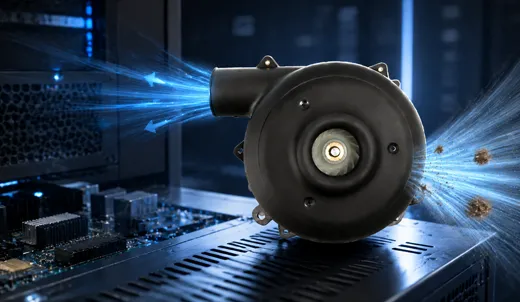
As computing power increases, thermal management becomes critical for modern electronic components. Miniature DC blower fans and compact centrifugal blowers are widely used to cool modern electronics. Applications include telecom base stations, enterprise server racks, industrial PCs, laser equipment, and medical diagnostic hardware.
Standard axial fans often stall when blowing air against dense heatsink fins. Compact blowers generate the necessary static pressure to force cooling air through tightly packed electronic modules. This targeted airflow removes localized heat spots, prevents thermal throttling, and extends component lifespans.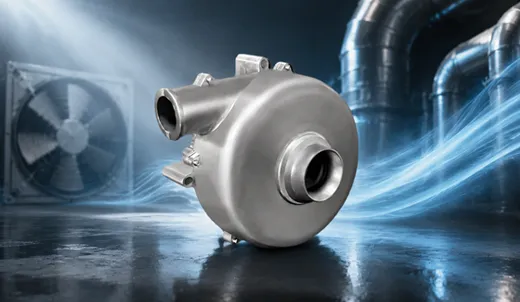
2.6 Modern Agriculture and Aquaculture Aeration
In commercial livestock and poultry farming, blowers maintain proper climate control. Large-scale chicken coops and pig facilities use blowers to exhaust ammonia gases, control humidity, and lower animal respiratory disease rates.
In commercial aquaculture, high-pressure ring blowers connect to networks of submerged perforated pipes to aerate commercial fish and shrimp ponds. Unlike surface paddle-wheel aerators, submerged blower systems deliver uniform oxygen levels throughout the entire water column. This supports higher stocking densities and reduces overall energy costs per acre.
2.7 Residential Consumer Appliance Integration
While often hidden from view, miniature blowers are integrated into many common household appliances. Standard residential applications include:
- Forced-air ventilation inside modern pellet stoves and gas fireplaces.
- High-pressure air generation inside multi-stage residential air purifiers.
- Convective heat distribution inside modern commercial and residential clothes dryers.
- High-velocity air discharge inside commercial automatic hand dryers.
Whenever a consumer product requires a focused, forceful, and reliable stream of air from a compact internal footprint, a miniature blower fan is typically the preferred component.
2.8 Industrial Parts Drying, Wind Knife Water Stripping
Automated manufacturing lines use high-pressure blowers for surface treatment, water stripping, and parts drying. Beverage bottling plants, glass manufacturing installations, and automotive component lines use blowers to clean parts after washing processes.
High-pressure blowers force air through narrow structural nozzles called air knives, creating a high-velocity air curtain. This air curtain instantly strips away water droplets and surface dust without touching or scratching the product. This automated process ensures clean surfaces before labeling, painting, or final packaging.
3. Taxonomy: Selecting the Right Blower Category
Industrial blowers are categorized by their mechanical design, pressure output, and performance capabilities:
- Centrifugal Blowers: The most widely adaptable design. Ideal for factory dust collection, commercial HVAC systems, facility exhaust, and medium-pressure ducted ventilation.
- Rotary Lobe Roots Blowers: Positive-displacement machines that deliver stable, high air volumes against high resistance. Ideal for municipal wastewater aeration and heavy-duty pneumatic material conveying.
- High-Pressure Regenerative Blowers: Compact units that produce high static pressures. Ideal for air knife water stripping, targeted industrial drying, and deep-water pond aeration.
- Miniature DC Blower Fans: Low-voltage, compact air movers. Ideal for electronics cooling, server thermal management, and consumer appliance integration.
- Specialized Anti-Corrosive / Explosion-Proof Blowers: Built with stainless steel, PP, or spark-proof aluminum. Designed to handle volatile chemical fumes, explosive gases, or highly corrosive industrial environments.
4. Why Choose an Air Blower Over a Conventional Fan?
- High Resistance Capabilities: Blowers maintain stable volumetric airflow even when pushing through complex duct networks, inline HEPA filters, and mechanical bends. Standard fans often stall under these conditions.
- Focused, Directional Delivery: The structural discharge port allows air to be targeted precisely where it is needed, minimizing energy waste.
- Industrial Reliability: Industrial air blowers are engineered for continuous 24/7/365 operation, helping prevent unscheduled plant downtime.
- Custom Engineering Adaptability: Blower housings and internal coatings can be customized to resist high temperatures, chemical corrosion, spark risks, and excessive ambient noise.
5. Technical FAQ: Common Inquiries Regarding Air Blowers
Q1: What is the main purpose of an air blower in industrial settings?
The primary purpose of an industrial air blower is to deliver a concentrated, pressurized stream of gas or air to overcome system static pressure resistance. This enables critical industrial tasks such as dust collection, pneumatic product transport, chemical fume extraction, wastewater aeration, and automated parts drying.
Q2: How do you differentiate a centrifugal blower from an axial cooling fan?
An axial fan moves air parallel to the fan blade shaft, providing high volume but very little pressure—ideal for open spaces. A centrifugal blower draws air inward axially and expels it outward at a 90-degree angle, generating high static pressure to push air through ducts and filters.
Q3: Can an air blower be utilized for indoor temperature cooling?
Yes. When integrated into HVAC ducted frameworks, ventilation systems, or electronic server cabinet configurations, air blowers provide forced-air cooling. They excel at cooling high-heat, enclosed areas where standard open-frame fans cannot overcome system resistance.
Q4: What specific air blower design is ideal for sewage water aeration?
Rotary lobe Roots blowers and multi-stage side-channel regenerative blowers are preferred for sewage aeration. They provide the high static pressure required to overcome water head pressure at the bottom of deep treatment tanks, ensuring a consistent supply of dissolved oxygen.
Q5: How does pneumatic conveying with a blower compare to a mechanical conveyor belt?
Pneumatic conveying uses a high-pressure blower to transport dry bulk powders through enclosed piping. This layout eliminates dust spills, prevents product contamination from ambient air, protects against environmental moisture, and simplifies vertical or complex factory routing.
Q6: What engineering parameters are critical when choosing an industrial blower?
The most critical specifications are Volumetric Flow Rate (measured in CFM or m³/h) and System Static Pressure Resistance (measured in inches of water gauge or Pascals). Engineers must also consider gas temperature, chemical corrosiveness, explosive risks, and targeted ambient noise levels.
Q7: Can standard air blowers handle hazardous chemical fumes safely?
Standard blowers cannot safely handle explosive or corrosive gases. Volatile industrial chemical applications require specialized anti-corrosive or explosion-proof blowers built with spark-resistant aluminum, stainless steel, or PP housings, paired with explosion-proof (ATEX/Ex) rated motors.
Q8: Why are blowers used instead of compressors for air knife water stripping?
Air compressors generate ultra-high pressures but low volumes, making them inefficient for broad surface drying. High-pressure regenerative blowers produce the optimal combination of moderate pressure and high volume needed to power air knives efficiently, reducing factory electrical consumption.
6. Conclusion and Sourcing Advice
From compact DC blower fans in electronic devices to heavy-duty industrial centrifugal configurations, air blowers are essential across global manufacturing, agricultural, commercial, and municipal infrastructure. Choosing the correct model requires balancing airflow volume against system resistance while factoring in your specific operational environment.
Selecting the wrong equipment can lead to premature motor failure or poor system performance. If you need a customized, high-efficiency air blower configuration tailored to your specific application requirements, contact our technical engineering team for specialized support and procurement options.