


High-Pressure Blowers for Medical Drying Cabinets: The Ultimate Engineering Guide to Thermal Management & Sterilization Compliance
In modern healthcare, clinical, and laboratory environments, the reprocessing of medical devices is subject to uncompromising regulatory standards. From complex surgical instruments and multi-channeled endoscopes to dental tools and precision laboratory glassware, the disinfection and sterilization cycle is never complete without a definitive, residue-free drying process. Residual moisture left inside narrow lumens or stacked instruments poses a severe threat, serving as a primary breeding ground for biofilm formation, bacterial proliferation, and subsequent cross-contamination.
Conventional ventilation fans or standard axial cooling fans inherently lack the static pressure required to force heated air through high-density instrument trays, convoluted tubing networks, and multi-tiered containment racks. To overcome these thermodynamic and aerodynamic boundaries, medical OEMs and sterile processing departments (SPD) increasingly rely on specialized, industrial-grade high-pressure blowers for medical drying cabinets. These high-performance centrifugal blowing systems deliver a highly concentrated, relentless airflow that guarantees absolute volumetric penetration, uniform temperature equilibrium, and rapid moisture vaporization—fully satisfying global medical hygiene, sterilization, and safety compliance benchmarks.
Why Do Medical Drying Cabinets Demand High-Pressure Centrifugal Blowers?
Medical drying protocols differ fundamentally from typical industrial dehumidification. The spatial architecture inside a clinical drying chamber is incredibly dense. When multiple surgical kits are autoclaved, washed, and transferred into a sterile drying cabinet, they present massive airflow resistance. If the thermal system cannot maintain continuous, omnidirectional air penetration, micro-droplets remain trapped in hidden crevices. This leads to premium instrument rust, corrosion, premature mechanical failure, and failed biological indicator tests.
-
Overcoming High Static Resistance: Standard axial fans generate superficial, high-volume airflow that disperses immediately upon hitting a solid obstacle. Conversely, a high-pressure centrifugal blower compresses and directs airflow into a concentrated stream, creating the supreme static pressure necessary to drive moisture out of narrow channels, lumens, and complex joint assemblies.
-
Eliminating Damp Micro-Zones: High-pressure blowers facilitate rapid, 360-degree hot air circulation throughout the entire internal cavity of the medical cabinet. This eliminates localized cool spots or high-humidity stagnant pockets, ensuring that every instrument regardless of its placement on the tray receives identical thermal exposure.
-
Continuous 24/7 Duty Cycle with Low Acoustic Footprint: Hospital central sterile supply departments (CSSD) operate continuously around the clock. The air movement system must be exceptionally durable while adhering to strict hospital acoustic regulations. Utilizing premium brushless DC (BLDC) motors ensures minimal vibration, low noise emission, and a maintenance-free lifespan exceeding tens of thousands of continuous operational hours.
-
Moisture-Proof and Corrosion Resistance: Working within an enclosed environment saturated with evaporated moisture and chemical residues requires robust defense. Specialized medical blowers feature specialized engineering coatings, corrosion-resistant housings (such as high-grade PBT or aluminum alloys), and sealed, moisture-proof bearing structures to withstand permanent high-humidity exposure.
| Blower System Attributes | TKFAN High-Pressure Medical Blowers | Standard Industrial Cooling Fans |
|---|---|---|
| Static Pressure Performance | Ultra-High Static Pressure (Deep Lumen Penetration) | Low/Surface-Level Pressure (Deflected by Trays) |
| Motor Technology | Premium Brushless DC Motor (BLDC) | Brushed or Low-End AC Induction Motors |
| Acoustic Level (Noise) | Low Decibel, Balanced Rotor (Hospital Approved) | High Vibration and Constant Mechanical Noise |
| Environmental Protection | Moisture-Proof, High-Temp, Corrosion-Resistant | Standard IP20, Vulnerable to Moisture & Heat Failures |
| Operational Lifespan | Continuous 24/7 Long-Term Duty Cycle | Intermittent Duty Cycle (Prone to Overheating) |
Core Application Scenarios of High-Pressure Blowing Systems across Healthcare Sectors
The deployment of specialized high-pressure blowers directly dictates the clinical efficacy of thermal processing machinery. Based on the rigorous industry standards utilized by critical care facilities, these components are widely integrated across four primary verticals:
1. Sterile Drying Cabinets for Intricate Surgical Instrumentation
Following high-pressure steam autoclaving or automated chemical washing, complex stainless-steel surgical scissors, orthopedic drills, and hemostatic forceps retain significant water tension within their hinges and box locks. TKFAN high-pressure blowers force a steady, supercharged thermal air stream directly across these mechanical joints, flashing off residual moisture instantly to preserve physical integrity and guarantee immediate surgical readiness.
2. Endoscope and Flexible Lumened Device Reprocessing
Flexible endoscopes, colonoscopes, and lumened tools feature incredibly long, narrow internal biopsy and air/water channels. Natural ambient evaporation is impossible. High-pressure blowers connect seamlessly to internal manifold adapters, pushing a column of forced, filtered dry air straight through the entire length of the lumen, eliminating internal moisture and preventing the development of waterborne pathogens during storage.
3. Compact Specialized Cabinets for Dental and Outpatient Clinics
Private dental clinics, outpatient rooms, and specialized care centers utilize smaller, compact drying chambers. TKFAN specializes in miniaturized high-pressure brushless DC blowers that fit directly within tight, integrated machine footprints without sacrificing aerodynamic output, ensuring outpatient operations maintain premium hygienic turnover rates.
4. High-Precision Research and Clinical Laboratory Glassware Dehumidification
Analytical laboratories require volumetric glassware, beakers, test tubes, and culture vessels to be completely clear of any chemical or water spots, as minimal residue can compromise critical experimental results. Centrifugal high-pressure blowers sustain high-velocity convective airflow throughout the drying racks, delivering impeccable water-spot-free results that meet advanced global laboratory quality controls.
Advanced R&D Testing and Validation: Ensuring Supreme Acoustic and Aerodynamic Reliability
At TKFAN, our manufacturing and engineering philosophies are anchored on strict scientific validation. To guarantee that each high-pressure blower meets the uncompromising demands of the medical sector, we subject our air-moving components to intensive acoustic profiling, aerodynamic calibration, and environmental stress simulations. Below is a detailed look inside our advanced quality control and technical validation processes:
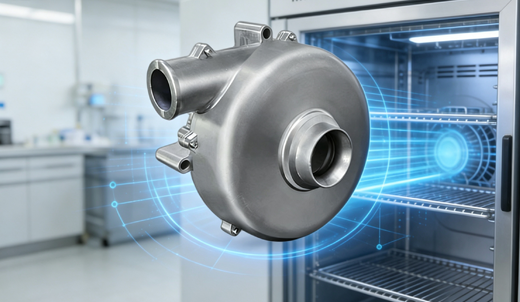
Figure 1: Comprehensive acoustic validation within the TKFAN state-of-the-art anechoic chamber. Real-time spectrum analyzers measure precise noise parameters (Lp, Leq, Lmax) to ensure all blowers operate well within hospital acoustic tolerance fields.
As demonstrated in Figure 1, acoustic control is paramount. Medical environments enforce ultra-low decibel limits to ensure patient comfort and operator safety. Our high-pressure blowers undergo extensive testing utilizing high-precision acoustic multi-functional sound level meters (such as the AWA6228 model analyzer) suspended inside full-bleed wedge anechoic chambers. This system intercepts stray sound reflections and measures exact decibel baselines (registering optimal ambient ratings as low as 31.2dB to 33.2dB under standard load). This extensive balance tuning prevents magnetic hums or physical vibrations from transmitting into the external medical cabinet housing.
Aerodynamic precision is further verified via state-of-the-art diagnostic instruments, as illustrated in Figure 2. We employ the advanced AMS2000R00 digital gas mass flow sensor (supporting real-time RS485 Modbus communications with operational limits up to 0.8MPa) to continuously monitor the air pressure profile. This diagnostic loop maps out the exact relationship between volumetric airflow and static resistance, ensuring that even when a drying cabinet is fully packed with surgical equipment, the TKFAN blower maintains a steady, non-dropping pressure drop curve to execute deep thermal purging.
Engineering Blueprint: How to Select the Ideal Blower for Medical Reprocessing Equipment
When designing or updating thermal management frameworks for medical drying cabinetry, purchasing engineers must evaluate component integration based on strict performance guidelines:
-
Prioritize Static Head Pressure Over Free-Air Volume: Do not choose a fan based solely on high CFM (Cubic Feet per Minute) free-air ratings. In dense drying chambers, static pressure (measured in Pa or mmH2O) is the critical force required to drive air through complex, multi-tiered trays.
-
Insist on True Brushless DC (BLDC) Topologies: Brushless configurations eliminate carbon dust pollution, reduce electromagnetic interference (EMI) with delicate monitoring electronics, and offer highly sensitive PWM speed control inputs for variable thermal programming.
-
Examine Thermal and Mechanical Tolerances: Drying cycles frequently operate at elevated temperatures ranging from 60°C up to 90°C for thermal disinfection. Ensure the selected cooling fan or blower is rated with Class H or Class F insulation materials and uses premium dual-ball bearings to avoid premature grease breakdown.
-
Strict Certifications and Regulatory Compliance: Medical equipment is bounded by rigid worldwide safety laws. Work exclusively with manufacturers whose blowers carry recognized CE, RoHS, UL, and TUV international marks, streamlining your final system medical device validation.
Technical FAQ: High-Pressure Blowers for Medical Reprocessing Chambers
Q1: Why are centrifugal blowers preferred over axial fans in medical drying cabinets?
A: Axial fans generate airflow parallel to the fan blade axis, which delivers high volume but very low static pressure, making it easily blocked by stacked instrument trays. Centrifugal blowers draw air in axially and redirect it radially at a 90-degree angle. This centrifugal force compresses the air column, creating high static pressure capable of forcing heated air deep into narrow lumens, tubing, and dense instrument blocks.
Q2: How does a brushless motor design (BLDC) prevent contamination inside sterile chambers?
A: Traditional brushed motors utilize carbon brushes that constantly rub against a mechanical commutator, generating microscopic carbon dust particles over time. If drawn into the drying stream, this dust can deposit directly onto newly disinfected medical equipment. Brushless DC (BLDC) motors use electronic commutation via integrated hall sensors, completely eliminating physical brush friction, preventing carbon particle emission, and ensuring clean air delivery.
Q3: Can these high-pressure blowers withstand continuous operation at 80°C to 90°C?
A: Yes, TKFAN specialized medical blowers are engineered with high-temperature resistant materials, utilizing premium PBT housings and specialized heavy-duty dual ball bearing assemblies packed with high-temperature synthetic lubricants. This design prevents lubricant volatilization and maintains reliable mechanical performance even during continuous thermal disinfection cycles up to 90°C.
Q4: What control options are typically integrated for smart medical drying programs?
A: TKFAN high-pressure blowers support advanced four-wire control configurations, including Pulse Width Modulation (PWM) speed adjustment inputs and Frequency Generator (FG) tachometer speed signal outputs. This allows the central motherboard of the medical drying cabinet to dynamically ramp up blower velocity during high-resistance lumen cycles or reduce RPMs to save energy during standby storage phases.
Conclusion: Investing in specialized high-pressure blowers is paramount to elevating the sterilization integrity, reducing instrument turnover time, and expanding the operational lifespan of modern medical drying cabinet platforms. Partner with TKFAN to unlock elite industrial-grade air-moving solutions tailored precisely to your medical equipment blueprints.
GET A QUOTE
Table of Contents
Latest Post

What are external-rotor motors and internal-rotor motors, and what are the differences between them?
14 September, 2026
The Critical Role of Blower Sealing Performance in PAPR, Particle Counter, and CPAP Medical Systems
14 August, 2026
Air Particle Counter Solutions: Working Principles, Brands & Architecture
25 July, 2026