


Automotive Sensor Cleaning Solutions: A Technical Selection Guide for ADAS & LiDAR Systems
1. Why Are Automotive Sensor Cleaning Solutions Critical for Autonomy?
As vehicle autonomy scales from L2+ driver assistance to L4/L5 fully autonomous driving, the vehicle's perception relies entirely on an intricate suite of optical cameras, LiDARs, and radars. However, real-world driving exposes these sensors to harsh environmental contaminants including mud, rain, dust, snow, road salt, and insect splatters.
Implementing an OEM-grade automotive sensor cleaning solution is vital to avoid system disengagements and safety degradation caused by surface occlusions:
- LiDAR Signal Attenuation: Water droplets and dust particles scatter laser beams, resulting in severe data noise, point-cloud distortion, or false-obstacle detections.
- Camera Lens Blurring: Dirt streaks obscure camera lenses, causing Lane Keep Assist (LKA) and Traffic Sign Recognition (TSR) algorithms to fail instantly.
- Operational Safety Domain (ODD) Preservation: Automated cleaning maintains sensor clarity continuously, preventing emergency pull-overs in extreme weather.
Note: This guide focuses strictly on hardware-integrated, automotive-grade OEM sensor cleaning systems (such as high-pressure liquid pumps and brushless air-purging blowers), rather than consumer-grade chemical cleaning sprays or manual aftermarket solutions.
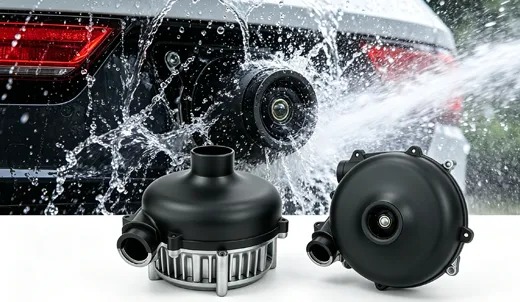
2. Comparative Analysis of Mainstream Automotive Sensor Cleaning Technologies
Modern automotive OEMs and Tier-1 suppliers combine three primary cleaning methods to build robust multi-sensor maintenance architectures:
| Cleaning Technology | Working Principle | Key Advantages | System Constraints |
|---|---|---|---|
| High-Pressure Liquid Wash | Telescopic or fixed nozzles spray washer fluid directly onto the sensor surface using high-pressure fluid pumps. | Highly effective against stubborn, dried-on mud, salt crusts, and organic debris. | Requires large fluid reservoirs; high consumption rate; leaves residual water marks; freezing risk in winter. |
| High-Velocity Air Purging | Uses compressed air or dynamic airflow generated by high-speed brushless blowers to blast away debris. | Zero fluid consumption; instant drying with zero water spots; ideal for rain, snow, and loose dust. | Requires compact, high-static-pressure automotive-grade air delivery hardware. |
| Mechanical / Ultrasonic | Integrated micro-wipers, rotating protective lenses, or surface ultrasonic vibrations. | Direct physical clearing for heavy snow or micro-droplet repulsion. | High mechanical wear; limited to flat/cylindrical geometries; high integration costs. |
3. System Architecture: Centralized vs. Decentralized Air-Based Cleaning
When engineering an air-purging automotive sensor cleaning solution, engineers typically evaluate two system layout configurations:
- Centralized Air-Wash Network: A single, high-output 80mm brushless blower or compressor distributes airflow through a manifold and pneumatic tubing to multiple sensors across the vehicle (roof LiDAR, front radar, rear camera). This simplifies power routing but requires careful management of ducting pressure drops.
- Decentralized Spot-Cleaning Array: Dedicated, ultra-compact 12V/24V brushless blowers are placed immediately adjacent to critical optical nodes (such as side-mirror cameras or roof LiDARs). This eliminates air duct routing losses and enables independent, targeted pulse cleaning cycles.
4. Why Air-Purging is Indispensable for All-Weather Autonomy
While fluid cleaning handles heavy mud, relying exclusively on liquid sprays causes operational bottlenecks. Air purging has become an essential baseline for autonomous fleets due to:
- Infinite Supply: Air is inexhaustible, ensuring uninterrupted sensor maintenance on long highway trips without running out of fluid.
- Optically Clear Finish: Blasts away residual water droplets instantly, preventing mineral lines and refraction errors on LiDAR optics.
- Non-Contact Coating Protection: Aerodynamic clearing protects delicate anti-reflective coatings from scratch damage caused by physical wipers.
- Active Rain Shielding: Continuous airflow across the lens prevents raindrops and snow from settling while driving.
5. TKFAN Brushless Blower Solutions for Automotive Sensor Cleaning
TKFAN supplies high-speed brushless DC blowers tailored for automotive-grade air purging cleaning networks, providing massive static pressure and rapid response times.
A. Specialized Blower Product Matrix
| Product Line / Series | Core Specifications | Target Application Domain | Action |
|---|---|---|---|
| Compact 12V DC Blower Series | AEC-Q100 compliant, ultra-compact footprint, optimized for low power consumption. | Decentralized cleaning for side-mirror cameras and optical surround sensors. | View Specs → |
| High-Pressure 24V DC Blower Series | Massive static pressure output, rapid spin-up response (<0.2s), high-efficiency impeller. | Pulse air purging for long-range roof-mounted LiDAR optics. | View Specs → |
| Centralized 80mm Blower Series | High volumetric airflow, engineered to overcome high ducting impedance. | Centralized air-wash networks serving multi-sensor clusters. | View Specs → |
| IP68 Automotive Sealed Series | Full vacuum resin encapsulation, IP68 waterproof/dustproof, -40°C to 85°C rated. | Chassis-mounted radars, front-grille sensors, and exterior environments. | View Specs → |
B. Manufacturing Excellence & Quality Standards
- Automotive Reliability (IP68 & AEC): Total-resin vacuum potting ensures IP68 seal protection and vibration resistance exceeding 20,000 operational hours.
- IATF 16949 Certified: Full APQP/PPAP compliance and component traceability meet strict Tier-1 and OEM vendor requirements.
- Custom R&D Simulation: In-house aerodynamic simulation and custom housing engineering for seamless integration into OEM vehicles.
C. Validated by Global Automotive Leaders
TKFAN blowers are integrated into autonomous fleets, Tier-1 suppliers, and global EV platforms:
Araymond
|
CHERY |
CHANGAN |
NEOLIX |
DONGHEE 6. Frequently Asked Questions (FAQ)
Q1: Why is air purging preferred over liquid washing for LiDAR optics?
A: LiDAR sensors rely on precise infrared optics. Liquid washes leave water residue and mineral lines that refract laser pulses. Air purging provides dry, spot-free clearing instantly without relying on a limited fluid tank.
Q2: How do automotive air cleaning systems perform in freezing conditions?
A: Unlike fluid nozzles that risk freezing, air systems operate without liquids, eliminating freeze-ups. TKFAN blowers are tested and certified down to -40°C.
Q3: What is the typical power draw of a sensor cleaning blower during operation?
A: Cleaning cycles operate in brief 0.5 to 2-second bursts. The average power consumption across a driving cycle is minimal and fully compatible with 12V and 24V vehicle power networks.
Table of Contents
Latest Post

What are external-rotor motors and internal-rotor motors, and what are the differences between them?
14 September, 2026
The Critical Role of Blower Sealing Performance in PAPR, Particle Counter, and CPAP Medical Systems
14 August, 2026
Air Particle Counter Solutions: Working Principles, Brands & Architecture
25 July, 2026