

The Definitive Guide to Miniature Blowers in Microbial Air Samplers: Engineering Precision, Efficiency, and Maximum Reliability
In the highly regulated domains of pharmaceutical manufacturing, cleanroom management, biotechnology, and public health safety, microbial air samplers stand as the unsung heroes of environmental monitoring. These precision instruments are tasked with a critical mission: capturing viable airborne microorganisms—such as bacteria, fungi, yeast, and spores—to ensure compliance with rigorous global standards like ISO 14644, FDA cGMP, and EU GMP Annex 1. At the very center of every high-performance microbial air sampler lies an indispensable mechanical component that dictates its overall accuracy: the miniature DC blower.
This comprehensive guide dives deep into the technical role of miniature blowers within microbial air sampling systems. We will explore how advanced blower aerodynamics, precise static pressure control, and Brushless DC (BLDC) motor technology directly impact the reliability of biological environmental monitoring, and why choosing a specialized manufacturer like TKFAN determines the ultimate success of your contamination control strategies.
1. Introduction: Why the Blower is the "Heart" of Microbial Air Sampling
The foundational operating principle of an active microbial air sampler is deceptively simple yet engineering-intensive: the device must aspirate an exact, pre-calibrated volume of environmental air over a specific timeframe, accelerating it through a perforated sampling head (sieve) so that viable particles impact reliably onto a collection medium, typically a nutrient agar plate or a liquid buffer.
For this biological collection mechanism to remain valid, the air sampling blower must deliver a perfectly steady, constant, and reproducible volumetric flow rate. Any fluctuation in airflow speed or negative pressure will lead to an incorrect volume calculation, completely invalidating the critical Colony Forming Unit (CFU) per cubic meter (CFU/m³) metrics. In high-stakes environments like sterile compounding pharmacies or vaccine manufacturing suites, a minor blower failure can trigger catastrophic false negatives or costly compliance breaches.
- Volumetric Flow Consistency: Providing exact, regulated flow rates—most commonly 28.3 LPM (1 CFM), 50 LPM, or 100 LPM—regardless of environmental pressure changes.
- Overcoming System Impedance: Maintaining superior static pressure to counteract the massive airflow resistance caused by particulate filters, micro-aperture sampling heads, and extensive internal tubing.
- Contamination-Free Operation: Running silently and cleanly without generating any carbon dust or metallic micro-particles that could compromise ultra-sterile cleanrooms.
2. Core Technical Functions of Miniature Blowers in Environmental Monitoring
A miniature blower acts as the primary vacuum force within an active air sampler. To understand its absolute necessity, we must break down its thermodynamic and aerodynamic responsibilities into three core vectors: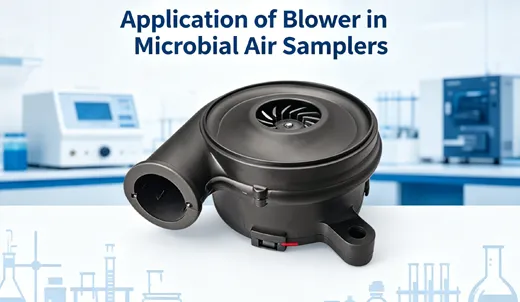
2.1 Closed-Loop Airflow Control and Auto-Calibration
Regulatory frameworks such as USP <797>, USP <800>, and ISO 14644-1 mandate that active air samplers maintain a volumetric accuracy tolerance of within ±5%. However, as the sampler operates, the micro-holes in the sieve head can get partially obstructed, or dust can load onto the pre-filters, increasing system resistance.
To overcome this, modern microbial air samplers utilize high-end Brushless DC (BLDC) blowers equipped with integrated digital feedback mechanisms, such as Hall effect sensors or sensorless vector control (FOC). When paired with an internal mass airflow sensor, a TKFAN BLDC blower can dynamically adjust its rotational speed (RPM) in real-time. If the system detects a drop in airflow due to filter loading, the intelligent controller immediately boosts the motor duty cycle to guarantee the flow rate stays fixed at exactly 100 LPM.
2.2 Static Pressure Management & High System Impedance
Air does not flow freely inside a microbial air sampler. It faces significant pneumatic friction. The air must be pulled through hundreds of laser-drilled micro-orifices (often 0.2mm to 0.4mm in diameter) on the impactor head to achieve the precise impaction velocity required to capture microbial particles without destroying their viability (the d50 cutoff point).
Standard axial cooling fans completely fail under these conditions because they lack the ability to generate static pressure. Specialized high-pressure miniature centrifugal blowers are mandatory. For instance, TKFAN's industrial-grade micro blowers are engineered to generate up to 16 kPa of static pressure. This extraordinary pressure head allows the sampling device to operate flawlessly even when hooked up to extended remote sampling lines, isolators, or heavily restrictive HEPA exhaust filters.
2.3 Zero Particle Generation (Ultra-Cleanroom Compliance)
Traditional brushed motors are strictly prohibited in cleanrooms because the physical friction between the carbon brushes and the commutator continuously sheds microscopic conductive carbon dust into the ambient atmosphere. This dust would not only contaminate the sterile environment but also settle onto the agar plates, leading to skewed laser particle counters or corrupted biological assays.
Advanced miniature blowers bypass this entirely by using brushless commutation technology. The stator and rotor never make physical contact, eliminating wear and particle shedding. Furthermore, premium manufacturers like TKFAN implement advanced dynamic balancing of the aluminum or composite impellers to sub-millimeter tolerances, ensuring zero grease leakage from the high-precision ball bearings and maintaining structural hermeticity.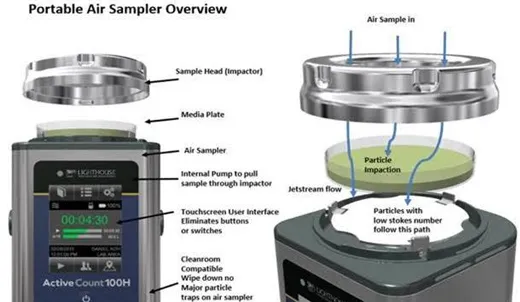
3. Comparative Overview: Axial Fans vs. Specialized Miniature Blowers
When engineering a biological air sampling instrument, selecting the wrong air-moving component can lead to complete product failure. The table below illustrates why specialized centrifugal miniature blowers are the gold standard:
| Performance Metric | Standard Axial Fan | TKFAN High-Pressure BLDC Blower |
|---|---|---|
| Static Pressure Capability | Extremely Low (0.05 - 0.5 kPa) | Exceptional (Up to 16+ kPa) |
| Airflow Under Load | Drops exponentially; prone to stalling | Remains highly stable via closed-loop FOC |
| Cleanroom Suitability | Poor (Risk of bearing outgassing) | Excellent (Shielded bearings, zero carbon dust) |
| Acoustic Noise Level | Moderate to high under pressure | Optimized ultra-quiet running (<50 dBA) |
| Lifespan (MTBF) | Short (10,000 - 20,000 hours) | Long-life industrial grade (50,000+ hours) |
4. Key Technical Specifications When Selecting a Blower for Air Samplers
Design engineers must evaluate several critical electro-mechanical metrics when sourcing a miniature blower for integration into portable or stationary cleanroom air samplers:
- Voltage Compatibility (12V / 24V DC): Portable handheld microbial air samplers rely on rechargeable lithium-ion battery packs. Sourcing a highly efficient 12V or 24V DC miniature blower ensures minimal power consumption, extending battery runtime to allow 8+ hours of continuous field sampling on a single charge.
- Aerodynamic Impeller Design: Forward-curved or backward-curved centrifugal impellers are engineered specifically to maximize fluid velocity profiles, optimizing the transition from kinetic energy to high static pressure within a compact housing footprint.
Thermal Dissipation & Compact Form Factor: In portable samplers, space is restricted. The miniature blower must feature an optimized thermal dissipation path (such as an aluminum housing heat-sink) to prevent heat from transferring to the internal sample chamber, as elevated temperatures can desiccate or kill the captured live bacteria on the agar media.
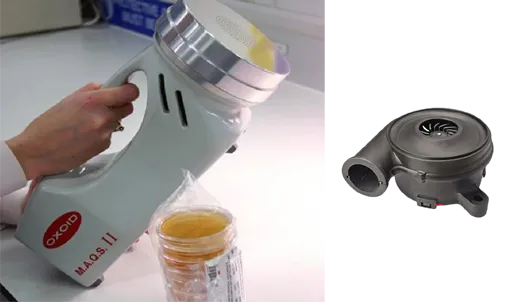
5. The TKFAN Advantage: Elevating Microbial Air Sampling Technology
As a global pioneer in the micro air-moving industry, TKFAN has developed a targeted portfolio of miniature high-pressure blowers engineered explicitly for medical, biological, and pharmaceutical instrumentation. Utilizing proprietary aerodynamic software and state-of-the-art automated manufacturing, TKFAN blowers deliver industry-leading power density, precise PWM speed control responsiveness, and unmatched structural durability.
By integrating TKFAN's advanced brushless miniature blowers into your microbial air sampler designs, you guarantee compliance with the most stringent global regulatory protocols, elevate your product's competitive edge, and ensure that every cubic meter of air monitored is backed by absolute mechanical precision.