

Selecting the Right Blower for a CPAP Machine
A technical breakdown of aerodynamic parameters, medical-grade materials, and dual-plane dynamic balance technologies for next-generation sleep apnea ventilators.
Introduction: Why CPAP Blower Selection Determines Ventilator Success
For medical device Original Equipment Manufacturers (OEMs), hardware R&D engineers, and sleep therapy device brands, the CPAP blower is the undisputed "heart" of any Continuous Positive Airway Pressure (CPAP) system. Whether you are developing a compact travel-sized CPAP, a premium home-use auto-adjusting (APAP) device, or a high-pressure Bilevel (BiPAP) non-invasive ventilator, the operational performance of your device is entirely bound to the capabilities of this miniature centrifugal blower.
Selecting an inappropriate blower can lead to severe system-level failures, including unstable therapeutic pressure outputs, excessive acoustic noise, premature bearing wear, and a failure to meet stringent global biocompatibility standards. Despite these risks, many procurement and engineering teams still fall into the trap of choosing standard industrial blowers for medical purposes, resulting in high warranty claim rates and poor patient compliance.
"Sourcing a high-quality medical-grade CPAP blower requires a detailed evaluation of aerodynamics, acoustic isolation, material safety, and manufacturing consistency. High-precision Chinese medical blowers, exemplified by TKFAN's innovative designs, have redefined the industry by offering performance that rivals traditional European, American, and Japanese brands."
1. Sizing and Categorization: Matching the Blower to Your Device Type
Before reviewing a blower’s data sheets, engineers must first establish the mechanical envelope and target application of the ventilator. Portable travel devices and standard domestic ventilators have entirely different design priorities.
1.1 Portable and Travel CPAP Devices: Sizing Constraints
Travel-friendly CPAP devices focus on compact dimensions, low physical weight, and battery-powered efficiency. Because these devices lack the space for extensive acoustic damping chambers or heavy internal mounting brackets, the selected blower must be exceptionally compact and power-efficient while still delivering adequate static pressure.
For these applications, miniature 40mm to 50mm blower platforms are the standard choice. TKFAN’s BA4028H24B (40×28mm) and BA5025H24B (50×25mm) blowers are designed precisely for this space-constrained category. Despite its miniature size, the BA4028H24B operates at speeds up to 48,000 RPM, delivering a maximum static pressure of 5.9 kPa to maintain consistent therapy pressure.
1.2 Premium Home-Use CPAP/BiPAP Ventilators: Performance Over Size
Standard home ventilators are larger, allowing for integrated active humidifiers, multi-stage noise barriers, and robust internal suspension systems. However, components such as water chambers, fine particulate filters, and long breathing circuits create high pneumatic resistance.
To overcome this system-level backpressure, home ventilators require larger blowers (58mm to 79mm) with substantial pressure reserves. The flagship BA5060H24B-A (58.7×59mm) blower delivers a peak static pressure of 8.4 kPa. This high pressure ensures stable airflow delivery even at high therapy settings and under heavy system resistance.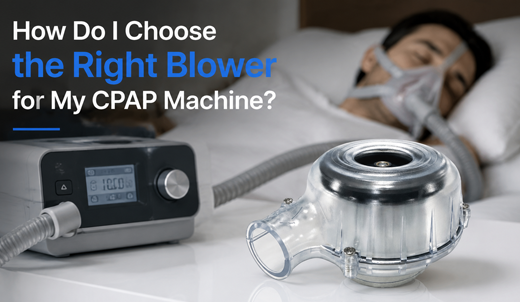
2. Crucial Performance Parameters for R&D Engineers
When selecting a CPAP blower, R&D engineers must analyze five primary parameters to ensure full compatibility with the device's pneumatic circuit and electronic control system.
| Model Number | Dimensions (mm) | Rated Voltage (V) | Max Pressure (kPa) | Max Airflow (CFM) | Max Speed (RPM) |
|---|---|---|---|---|---|
| BA4028H24B | 40 × 40 × 28 | 24V DC | 5.9 | 12.0 | 48,000 |
| BA5025H24B | 50 × 50 × 25 | 24V DC | 4.05 | 9.5 | 37,000 |
| BA5060H24B-A | 58.7 × 58.7 × 59 | 24V DC | 8.4 | 14.0 | 31,000 |
| BA7060H24B-C | 77 × 67 × 57 | 24V DC | 4.8 | 18.8 | 30,600 |
| BA7060H24B-K | 76 × 65 × 54 | 24V DC | 5.4 | 15.7 | 34,000 |
2.1 Rated Voltage Standard: 24V DC
Although 12V configurations are occasionally used for specialized battery-powered devices, 24V DC is the standard for medical ventilators. A 24V motor operating under full load achieves greater electrical efficiency, lower current draw, and reduced thermal generation compared to lower-voltage alternatives, ensuring stable long-term operation.
2.2 Static Pressure Capacity and Reserves
Standard sleep therapy pressures range from 4 to 20 cmH₂O (approx. 0.4 to 2.0 kPa). However, because internal filters and humidifiers restrict airflow, the blower must have a substantial pressure reserve to prevent pressure drops at the patient interface. We recommend selecting a blower with a static pressure rating of at least 4.0 kPa for travel units and at least 5.5 kPa for standard home devices.
2.3 Acoustic Emissions: Achieving Quiet Comfort
Acoustic noise is a critical factor for user compliance in home sleep therapies. Standard industrial fans often run at noise levels above 35 dBA, which can disrupt sleep. By using dual-plane balancing and precision bearings, medical-grade blowers like the TKFAN BA7060H24B-K maintain noise levels below 26.5 dBA at standard therapy pressures, ensuring quiet operation.
3. Double-Sided Dynamic Balance: Resolving Vibration and Noise At the Source
The primary difference between a high-end medical CPAP blower and a standard industrial fan is the balancing process applied to the rotating assembly.
Standard blowers typically rely on single-plane balancing, which corrects imbalance only on one side of the impeller. However, because a blower rotor is long, centrifugal force imbalances remain on other axial planes. When operating at speeds up to 48,000 RPM, this imbalance causes high-frequency micro-vibrations, resulting in increased noise and accelerated bearing wear.
To address this, advanced manufacturers like TKFAN use double-sided dynamic balancing technology. The blower's motor shaft is extended, with the main impeller mounted on the front and a precision brass counterweight placed at the rear. High-precision balancing equipment then analyzes both planes simultaneously, milling away microscopic amounts of material until the residual imbalance is virtually zero.
📊 Engineering Performance Impact:
Dual-plane dynamic balancing reduces residual vibration to less than 0.4 mm/s. This reduction in vibration lowers acoustic output and extends the bearing's L10 operating life to 50,000 to 70,000 hours, ensuring long-term reliability.
4. Biocompatibility, Safety, and Regulatory Standards
Because the blower delivers air directly into a patient's lungs, it must meet strict biocompatibility standards. General-purpose industrial blowers are not suitable for medical applications due to chemical outgassing risks.
4.1 ISO 10993 Biocompatibility
The impeller, scroll housing, and internal seals must be made from medical-grade, low-VOC engineering polymers. These materials are certified under ISO 10993 to ensure they do not release toxic particulate matter or volatile organic compounds (VOCs) during operation.
4.2 Cleanroom Production and Traceability
Medical-grade blowers are assembled in separate cleanrooms to prevent dust, grease, or industrial residues from settling in the air channels. Under ISO 13485 quality systems, every finished unit is engraved with a unique serial number linked to its raw material batch, assembly parameters, and dynamic balancing test data, ensuring full traceability.
Technical Q&A: Deep-Dive Into CPAP Blower Engineering
Q1: Why is dual-plane dynamic balancing critical for CPAP blowers but less important for standard industrial fans?
Industrial blowers run at lower speeds, making single-plane balancing sufficient. CPAP blowers operate at ultra-high speeds up to 48,000 RPM. At these velocities, even tiny imbalances generate significant vibrational forces, leading to noise levels over 32 dBA and accelerated bearing wear. Dual-plane balancing corrects mass distribution on both ends of the rotating shaft to keep vibration levels under 0.4 mm/s, ensuring quiet sleep environments and long lifespans.
Q2: What bearing types are used in medical-grade CPAP blowers and why?
High-end CPAP blowers utilize miniature ball bearings, specifically customized Japanese NMB ball bearings. Standard sleeve bearings wear out quickly at high RPMs, causing noise and performance degradation within months. Ball bearings handle high rotational speeds, maintain low friction, and resist wear, helping the blower reach a lifetime of 50,000 to 70,000 operating hours.
Q3: How do manufacturers prevent biological contamination of the therapeutic airflow?
First, all airway components are made of ISO 10993 biocompatible polymers with low VOC outgassing. Second, the blowers are assembled in separate cleanrooms to prevent dust, grease, or industrial residues from settling in the air channels. No industrial adhesives or recycled plastics are used in the process.
Q4: What is the significance of the ISO 13485 certification for a component manufacturer?
ISO 13485 is the international quality standard for medical device manufacturing. It requires strict design control, vendor qualification, complete material traceability (via an MES system), and robust corrective/preventive action (CAPA) systems, ensuring that every production run meets medical standards.
Q5: How do CFD simulations improve CPAP blower performance?
CFD allows engineers to model aerodynamic flow, turbulence, and velocity vectors within the scroll housing before building physical prototypes. This optimization maximizes pressure and airflow while preventing stall and backpressure instabilities, ensuring stable therapeutic pressure profiles.
Q6: Why is the choice of motor rotor magnets critical for BiPAP devices?
BiPAP machines must switch pressure levels rapidly with the patient's natural breathing cycle (Inspiratory vs. Expiratory). High-performance neodymium (NdFeB) magnets provide the high magnetic flux and low rotational inertia needed for the motor to accelerate and decelerate instantly without slipping or overheating.
Q7: How does an MES system assist in product quality tracing?
An MES (Manufacturing Execution System) tracks and records every stage of production for each individual unit via its laser-etched serial code. If a blower encounters an issue, the manufacturer can trace its exact assembly time, raw material batch, operator, and dynamic balancing metrics to identify and isolate potential issues.
Q8: What noise parameters are checked during outgoing quality control?
Each finished blower is tested under load in an acoustic chamber with a 22 dBA ambient background. The blower is evaluated at 10 cmH₂O static pressure; only units emitting under 26.5 dBA of overall sound pressure (and displaying no unusual frequency spikes) are approved for delivery.
Q9: What is the L10 operating lifetime of a medical CPAP blower?
The L10 lifetime is the point at which 10% of a tested population is expected to fail. While cheap blowers average around 30,000 hours, premium-grade Chinese CPAP blowers achieve L10 lifetimes of 50,000 to 70,000 hours (translating to over 15 years of nightly use) thanks to precision balancing and premium Japanese NMB bearings.
Q10: How do Chinese medical blowers prevent electromagnetic interference (EMI)?
CPAP blowers are tested to meet IEC 60601-1-2 EMC standards. The brushless motor, internal wiring, and drive boards are designed to prevent electromagnetic interference, protecting the sensitive flow and pressure sensors inside the ventilator.