

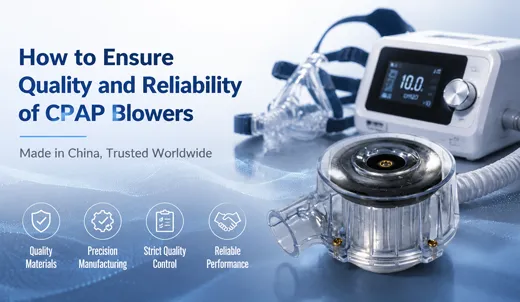
Ensuring Quality and Reliability of Chinese-Made CPAP Blowers: The Ultimate Manufacturer's Guide
How medical-grade engineering, dual-plane dynamic balancing, and ISO 13485 automation redefine Chinese CPAP blower manufacturing for global ventilator OEMs.
Introduction: The Critical Role of CPAP Blowers in Sleep Apnea Therapy
At the heart of every Continuous Positive Airway Pressure (CPAP), Bi-level Positive Airway Pressure (BiPAP), and Auto-adjusting Positive Airway Pressure (APAP) machine lies a highly specialized airflow component: the CPAP blower (also known as a micro medical centrifugal blower). This high-speed motor-impeller assembly is the single most critical factor in determining the clinical efficacy of sleep apnea therapies. For global medical device original equipment manufacturers (OEMs), distributors, and respiratory device brands, sourcing reliable components is paramount. However, when evaluating a CPAP blower made in China, the primary concerns consistently revolve around mass-production consistency, long-term operational lifespan, and medical compliance.
Over the past decade, the landscape of Chinese micro-medical blower manufacturing has undergone a profound transformation. Led by industry-pioneering manufacturers like TKFAN, top-tier Chinese suppliers have systematically shattered the old stereotype of low-quality, inconsistent components. By establishing a fully closed-loop quality control ecosystem—spanning medical-grade structural design, premium raw material selection, automated production lines, advanced dual-plane dynamic balancing, and comprehensive multi-dimensional reliability testing—high-quality Chinese CPAP blowers now stand as world-class, cost-effective alternatives to traditional European, American, and Taiwanese brands such as Boreasa, Delta, and ebm-papst.
"Low-end or unverified blowers frequently suffer from excessive vibration, noise levels exceeding 32 dBA, unstable pressure delivery under humidifier backpressure, premature bearing failure, and toxic volatile organic compound (VOC) emissions from low-grade plastics. These structural failures lead directly to ventilator malfunctions, clinical discomfort, soaring warranty claims, and catastrophic product recalls."
This comprehensive guide details the rigorous, engineering-backed strategies employed by elite manufacturers like TKFAN to guarantee that every single mass-produced CPAP blower delivers uncompromising performance. For a deeper look at specific models, you can explore the official TKFAN CPAP Air Blower Product Catalog.
1. Medical-Grade Engineering Design: Eradicating Inherent Defects at the Source
High-quality performance cannot be inspected into a product; it must be designed into it. Unlike general-purpose industrial blowers, medical CPAP blowers must meet strict clinical requirements: ultra-quiet night-time operation, rapid dynamic pressure responses (especially for BiPAP devices), and completely biocompatible air channels. Elite Chinese manufacturers eliminate structural failure modes at the design phase through advanced aerodynamics and material sciences.
1.1 Dual-Plane Dynamic Balancing: The Standard for Silent Operation
Excessive vibration and noise are the primary failure points of low-end CPAP blowers. Cheap, generic manufacturers often rely on single-plane dynamic balancing, which only balances the impeller at one end of the shaft. However, because the rotor of a CPAP blower is elongated, unbalanced forces remain on other planes along the axis. When rotating at speeds between 30,000 RPM and 48,000 RPM, this residual unbalance causes severe micro-vibrations, pushing noise levels past 32 dBA and causing rapid bearing wear.
To resolve this, advanced manufacturers like TKFAN utilize dual-plane dynamic balancing technology. By placing a premium pneumatic impeller at the front of an elongated brushless DC (BLDC) motor shaft and a precise brass counterweight at the rear, the entire rotating assembly is balanced across two separate planes. Advanced automatic balancing machines mill microscopic amounts of material from designated zones until the residual unbalance is virtually zero.
📊 Performance Insight (TKFAN BA7060H24B-K):
Under a standard clinical load of 10 cmH₂O pressure, a standard single-plane balanced blower registers a noisy 33 to 36 dBA. In contrast, the dual-plane balanced TKFAN blower runs at an ultra-quiet 26.5 dBA (with a 22 dBA background ambient noise). This process reduces bearing fatigue, extending the blower's L10 operating life to 50,000 to 70,000 hours, compared to the 30,000-hour industry average.
1.2 CFD Aerodynamic Simulations for Stable Pressure Delivery
A CPAP blower must maintain steady pressure and airflow even when facing varying resistance from humidifiers, bacterial filters, narrow breathing tubes, and patient mask leaks. If the internal scroll housing is poorly designed, high backpressure can cause aerodynamic stall, leading to pressure fluctuations that disrupt the patient's breathing cycle.
By using 3D Computational Fluid Dynamics (CFD) simulations, engineers optimize blade angles, scroll profiles, and inlet/outlet geometry across the entire 40mm to 70mm product range to maximize static pressure efficiency:
- Ultra-Compact BA4028H24B (40mm): Generates up to 5.9 kPa of static pressure and 12 CFM of airflow, optimized for travel-friendly, portable CPAP devices.
- Mid-Sized BA5060H24B-A (50mm): Features a high static pressure of 8.4 kPa, making it ideal for standard home-use CPAP systems with high therapeutic pressure settings.
- High-Flow BA7060H24B-C (70mm): Outputs an impressive 18.8 CFM of airflow, tailored for heavy-duty, multi-mode clinical BiPAP and APAP machines.
1.3 ISO 10993 Biocompatibility: Zero Toxic Outgassing
Past industry recalls highlighted the danger of using non-medical materials, where degraded acoustic foams and low-grade plastics released toxic particulate matter and VOCs into the patient's airway. Top-tier Chinese CPAP blower manufacturers avoid these risks by ensuring that all components in the air channel (including the impeller, housing, and silicone seals) are made from medical-grade, low-VOC engineering plastics. These materials are certified to meet ISO 10993 standards for cytotoxicity, sensitization, and intracutaneous reactivity, with batch reports verified by independent testing firms like SGS.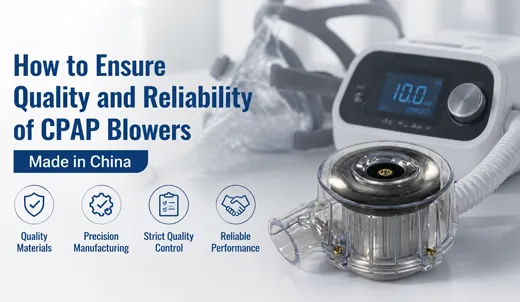
2. Rigorous Supply Chain Control and Raw Material IQC
A reliable design is only as good as the raw materials used to build it. To ensure consistent quality, top manufacturers implement a strict Incoming Quality Control (IQC) protocol, performing 100% inspections on critical components to prevent the use of sub-standard parts.
| Critical Component | Material/Specification | Quality Control Protocol (IQC) |
|---|---|---|
| Bearings | Original Japanese NMB Miniature Ball Bearings | 100% inspection for rotational torque, vibration noise spectrum, and high-temperature lubricant stability. |
| BLDC Motor Coils | High-purity oxygen-free copper wire (Class H, 180°C) | Insulation resistance testing, dielectric breakdown tests, and high-frequency coil surge testing. |
| Rotor Magnets | Sintered NdFeB (Neodymium) with high thermal stability | Magnetic flux density mapping, surface plating salt spray corrosion testing, and thermal demagnetization testing. |
| Airway Plastics | ISO 10993 Certified Medical-Grade LCP / Polycarbonate | SGS material certifications verification, melt flow index testing, and volatile organic compound (VOC) headspace GC-MS analysis. |
3. MES-Driven Smart Automation: Eliminating Human Variance
Inconsistent manual assembly is a major cause of quality drift in low-end manufacturing. To ensure high precision across thousands of units, top Chinese medical blower manufacturers utilize custom automated assembly lines integrated with digital Manufacturing Execution Systems (MES).
Automation is used for critical assembly steps—such as rotor-to-shaft pressing, high-precision impeller installation, and ultrasonic housing welding. Robots control press-fit depths within microscopic tolerances (under 2 micrometers), preventing issues like impeller slip, shaft misalignment, or housing air leaks. High-resolution AI vision inspection systems scan each unit during assembly to detect surface micro-cracks, material flashing, or seal misalignments.
Additionally, every blower receives a unique laser-etched 2D barcode linked to the MES database. The system automatically records its specific raw material batch, automated assembly parameters, and dual-plane dynamic balancing data. This level of traceability allows manufacturers to quickly locate root causes if a field issue occurs, reducing recall risks for medical device brands.
4. Multi-Tiered Testing: 100% Outgoing Quality Assurance
Reliable manufacturers run comprehensive quality checks on every finished product before it leaves the factory, combining 100% end-of-line testing with destructive batch stress testing.
4.1 Standardized End-of-Line (EOL) Performance Verification
Every single CPAP blower is connected to a calibrated aerodynamic testing rig to verify critical operating parameters: static pressure curves from 4 to 40 cmH₂O, current draw under variable backpressures, open flow rates up to 200 L/min, and PWM speed-control responsiveness. Any unit that deviates from the performance curve by even 1.5% is rejected.
4.2 Semi-Anechoic Acoustic and Vibration Profiling
Because quiet operation is essential for sleep apnea devices, acoustic testing is performed on all units. Testing takes place in a specialized semi-anechoic chamber with a 22 dBA background noise floor. Each blower is tested at 10 cmH₂O; those exceeding 26.5 dBA or showing abnormal vibration signatures are routed for dynamic re-balancing.
4.3 High-Accelerated Life Testing (HALT)
To confirm long-term reliability under stressful conditions, random samples from each batch undergo rigorous environmental testing, including:
- Thermal Cycling: Repeatedly cycling between -20°C and +60°C to test physical stability.
- High-Humidity Storage: 95% relative humidity testing to ensure electrical insulation and prevent corrosion.
- Pressure Cycle Fatigue: 100,000 rapid cycles simulating BiPAP pressure transitions.
Continuous Aging: 1,000 hours of continuous run-time at maximum RPM and high operating temperatures.
5. Comprehensive Regulatory Compliance & Quality Systems
A manufacturer's internal quality management system provides the foundation for consistent production. Elite Chinese CPAP blower suppliers maintain international certifications to streamline compliance for global markets:
- ISO 13485: The gold standard quality management system for medical device components, regulating design, procurement, manufacturing, and traceablity.
- IEC 60601-1: Ensures electrical safety and electromagnetic compatibility (EMC), protecting sensitive ventilator sensors from electrical noise.
- RoHS & REACH: Verifies the absence of hazardous substances, ensuring compliance with European environmental standards.
All certifications and testing documentation are readily available to simplify the regulatory approval process (such as FDA, CE MDR, or NMPA registration) for device manufacturers.
6. Maintaining Quality Consistency Across Multi-Year Production
To prevent the "quality drift" often experienced with unverified suppliers (where later batches fail to match the quality of the initial samples), top-tier manufacturers implement strict quality-preservation policies:
- Golden Sample Archiving: The manufacturer permanently archives approved samples from the first production run. All subsequent batches are tested against these archived samples to ensure performance baseline consistency.
- Change-Control Integrity: No changes to raw materials, sub-vendors, or assembly processes can be made without formal, written customer approval.
- Third-Party Pre-Shipment Inspections: Global buyers can contract independent inspection agencies (such as TÜV or Intertek) to perform random inspections and performance verifications before shipping.
Performance Comparison: Chinese vs. Global Brand CPAP Blowers
Data from independent testing demonstrates how high-end Chinese CPAP blowers (such as the TKFAN BA7060H24B-K) compare to traditional high-end international models:
| Performance Indicator | Standard Low-End Blower | TKFAN Medical CPAP Blower | Global Premium Brands |
|---|---|---|---|
| Noise Level (at 10 cmH₂O) | 33 dBA ~ 36 dBA | 26.5 dBA | 26.0 dBA ~ 27.5 dBA |
| Residual Vibration Level | > 1.5 mm/s | < 0.4 mm/s | < 0.5 mm/s |
| L10 Operating Lifespan | ~ 30,000 Hours | 50,000 ~ 70,000 Hours | 50,000 ~ 65,000 Hours |
| Batch-to-Batch Drift Rate | ± 6.0% ~ 10.0% | ± 1.5% | ± 1.5% |
| Biocompatibility Assurance | None / Uncertified | ISO 10993 Certified | ISO 10993 Certified |
Technical Q&A: Deep-Dive Into CPAP Blower Engineering
Q1: Why is dual-plane dynamic balancing critical for CPAP blowers but less important for standard industrial fans?
Industrial blowers run at lower speeds, making single-plane balancing sufficient. CPAP blowers operate at ultra-high speeds up to 48,000 RPM. At these velocities, even tiny unbalances generate significant vibrational forces, leading to noise levels over 32 dBA and accelerated bearing wear. Dual-plane balancing corrects mass distribution on both ends of the rotating shaft to keep vibration levels under 0.4 mm/s, ensuring quiet sleep environments and long lifespans.
Q2: What bearing types are used in medical-grade CPAP blowers and why?
High-end CPAP blowers utilize miniature ball bearings, specifically customized Japanese NMB ball bearings. Standard sleeve bearings wear out quickly at high RPMs, causing noise and performance degradation within months. Ball bearings handle high rotational speeds, maintain low friction, and resist wear, helping the blower reach a lifetime of 50,000 to 70,000 operating hours.
Q3: How do manufacturers prevent biological contamination of the therapeutic airflow?
First, all airway components are made of ISO 10993 biocompatible polymers with low VOC outgassing. Second, the blowers are assembled in separate cleanrooms to prevent dust, grease, or industrial residues from settling in the air channels. No industrial adhesives or recycled plastics are used in the process.
Q4: What is the significance of the ISO 13485 certification for a component manufacturer?
ISO 13485 is the international quality standard for medical device manufacturing. It requires strict design control, vendor qualification, complete material traceability (via an MES system), and robust corrective/preventive action (CAPA) systems, ensuring that every production run meets medical standards.
Q5: How do CFD simulations improve CPAP blower performance?
CFD allows engineers to model aerodynamic flow, turbulence, and velocity vectors within the scroll housing before building physical prototypes. This optimization maximizes pressure and airflow while preventing stall and backpressure instabilities, ensuring stable therapeutic pressure profiles.
Q6: Why is the choice of motor rotor magnets critical for BiPAP devices?
BiPAP machines must switch pressure levels rapidly with the patient's natural breathing cycle (Inspiratory vs. Expiratory). High-performance neodymium (NdFeB) magnets provide the high magnetic flux and low rotational inertia needed for the motor to accelerate and decelerate instantly without slipping or overheating.
Q7: How does an MES system assist in product quality tracing?
An MES (Manufacturing Execution System) tracks and records every stage of production for each individual unit via its laser-etched serial code. If a blower encounters an issue, the manufacturer can trace its exact assembly time, raw material batch, operator, and dynamic balancing metrics to identify and isolate potential issues.
Q8: What noise parameters are checked during outgoing quality control?
Each finished blower is tested under load in an acoustic chamber with a 22 dBA ambient background. The blower is evaluated at 10 cmH₂O static pressure; only units emitting under 26.5 dBA of overall sound pressure (and displaying no unusual frequency spikes) are approved for delivery.
Q9: What is the L10 operating lifetime of a medical CPAP blower?
The L10 lifetime is the point at which 10% of a tested population is expected to fail. While cheap blowers average around 30,000 hours, premium-grade Chinese CPAP blowers achieve L10 lifetimes of 50,000 to 70,000 hours (translating to over 15 years of nightly use) thanks to precision balancing and premium Japanese NMB bearings.
Q10: How do Chinese medical blowers prevent electromagnetic interference (EMI)?
CPAP blowers are tested to meet IEC 60601-1-2 EMC standards. The brushless motor, internal wiring, and drive boards are designed to prevent electromagnetic interference, protecting the sensitive flow and pressure sensors inside the ventilator.