

What is a Brushless Blower? How Does It Work inside a CPAP Machine?
Technical Guide | Published by TKFan Medical Air Solutions
At the heart of every Continuous Positive Airway Pressure (CPAP) device lies a critical electromechanical component: the CPAP blower. Without a precision-engineered brushless blower, medical devices cannot deliver the stable, continuous pressurized airflow required to treat Obstructive Sleep Apnea (OSA). In the modern medical hardware industry, Brushless DC (BLDC) blowers have completely replaced legacy brushed components, becoming the standard benchmark for premium home-use and portable ventilators.
The shift towards BLDC technology is driven by four clinical-grade pillars: ultra-low acoustic signatures, exceptional operational lifespans, millisecond-level pressure regulation, and medical-grade biocompatibility. This comprehensive technical guide breaks down the definition, mechanical anatomy, and operational physics of brushless blowers within CPAP, BiPAP, and APAP sleep therapy systems, paired with technical insights from TKFan's proprietary engineering benchmarks.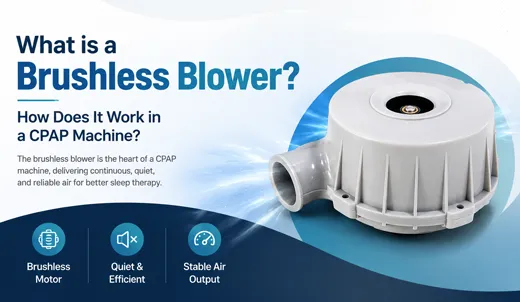
1. Understanding the Anatomy of a Brushless Blower
Defining the Brushless DC (BLDC) Blower
A brushless blower is an ultra-high-speed centrifugal air pump driven by a brushless DC motor, completely eliminating the carbon brushes and mechanical commutators found in legacy motors. While traditional motors rely on physical contact to alternate currents—causing friction, carbon dust, and electrical arcing—a brushless DC blower utilizes an independent electronic drive board and rotor position sensing circuits to execute electronic commutation flawlessly.
Core Components of a Medical-Grade CPAP Blower
A standardized 24V DC medical blower designed for respiratory therapy consists of six interconnected engineering modules:
- BLDC Stator Assembly: Stationary copper windings housed within the outer casing that generate a dynamic, rotating electromagnetic field when energized.
- Permanent Magnet Rotor with Extended Shaft: Embedded with high-coercivity Neodymium (NdFeB) permanent magnets. TKFan’s signature extended-shaft configuration allows for comprehensive dual-plane dynamic balancing.
- Centrifugal Impeller: An aerodynamically optimized wheel made from medical-grade, zero-VOC (Volatile Organic Compound) polymers to ensure patient bio-safety according to ISO 10993 standards.
- Volute Scroll Housing: A spiral outer casing designed to smoothly convert high-velocity kinetic energy into stable static pressure while dampening turbulent air noise.
- Premium Dual Ball Bearings: Sourced from top-tier brands like Japan NMB, ensuring an L10 operational life of 50,000 to 70,000 hours of continuous running.
- Sensorless Controller Board: A microcoded PCB that processes Pulse Width Modulation (PWM) or 0–5V analog inputs from the CPAP motherboard to instantly step the motor speed up or down.
Performance Analysis: Brushless vs. Brushed Blowers
| Specification | TKFan BLDC CPAP Blower | Conventional Brushed Blower | Clinical Impact on Patient |
|---|---|---|---|
| Commutation | Electronic (Contactless) | Mechanical Brushes | Eliminates carbon dust inhalation risks and motor arcing. |
| Noise Level (@10cm H2O) | < 26.5 dB(A) | 40 – 55 dB(A) | Whisper-quiet sleep environment for patient and partner. |
| Lifespan (L10) | 50,000 – 70,000 Hours | 8,000 – 15,000 Hours | Ensures 5–8 years of maintenance-free medical operation. |
| Dynamic Response | Instantaneous (Milliseconds) | Lagging & Inefficient | Flawlessly syncs with BiPAP/APAP breathing cycles. |
2. How a Brushless Blower Executes Airway Pressurization
The operational physics of a brushless DC blower inside a CPAP device relies on digital phase switching combined with centrifugal fluid dynamics. This sequence unfolds in three distinct mechanical stages:
Step 1: Contactless Digital Commutation
Instead of relying on wearing components, the driver board acts as the brain, delivering precise sequential three-phase voltage pulses to the stator coils. This action generates a rapidly spinning magnetic field that pulls the permanent magnet rotor along with it. Operating smoothly between 30,000 RPM and 48,000 RPM, this optimized system removes all physical friction points, reducing thermal output and maximizing energy efficiency.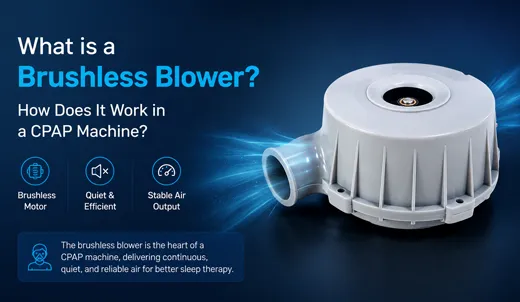
Step 2: Centrifugal Compression Mechanics
As the rotor accelerates, the coupled high-speed impeller drives the aerodynamic cycle forward:
- Intake: Ambient room air passes through the CPAP's high-efficiency particulate air (HEPA) inlet filter and enters the low-pressure eye of the impeller.
- Acceleration: The rapidly spinning curved blades throw the air outward radially via centrifugal force, exponentially increasing its kinetic velocity.
- Conversion: The air is compressed as it enters the widening volute scroll channel, converting velocity into steady, uniform static pressure ($4\text{ to }25\text{ cm }H_2O$).
- Delivery: The pressurized airstream exits the blower, passing through the humidifier chamber and hose delivery kit to safely splint the patient's airway.
3. Integration across CPAP, APAP, and BiPAP Systems
Modern respiratory platforms require dynamic pressure adjustments to support varying clinical treatments. A premium brushless blower easily adapts to different modes through high-speed closed-loop feedback:
- Fixed CPAP Mode: The blower maintains a single prescribed pressure level all night, automatically compensating for minor mask leaks by tweaking motor RPM.
- APAP (Auto-adjusting) Mode: Advanced algorithms continuously monitor airway resistance. If an apnea event is detected, the blower accelerates within milliseconds to boost pressure, scaling back down once regular breathing resumes.
- BiPAP (Bilevel) Mode: This mode requires the blower to track the exact moments of inhalation and exhalation. It rapidly spins up to deliver a higher Inpiratory Positive Airway Pressure (IPAP) and quickly drops down to a lower Expiratory Positive Airway Pressure (EPAP), reducing breathing fatigue for the user.
4. Engineering Breakthrough: TKFan Dual-Plane Dynamic Balancing
The defining feature of TKFan's medical blowers is our proprietary Dual-Plane Dynamic Balancing process. Traditional micro-blowers are typically balanced on a single plane, addressing weight distribution only on the impeller face. However, at speeds exceeding 40,000 RPM, residual imbalances deeper within the rotor core can lead to micro-vibrations, shortened bearing lifespans, and unwanted structural noise.
"By extending the motor shaft on both ends, TKFan calibrates both Plane A (the impeller side) and Plane B (the rear counterweight). This precision machining reduces residual vibration to near-zero levels, keeping operational noise safely under 26.5 dB(A)."
Technical Frequently Asked Questions (FAQ)
Q1: What is the main structural difference between medical and industrial brushless blowers?
Medical blowers utilize strict biocompatible (ISO 10993 approved) zero-VOC polymers, high-precision dual-plane balanced rotors for sleep-safe acoustics (<30 dBA), and ultra-low inertia impellers for millisecond-level speed variations. Industrial models prioritize raw volume and pressure over noise, vibration dampening, and biological safety.
Q2: Can a single TKFan brushless blower support CPAP, APAP, and BiPAP therapy profiles?
Yes. Thanks to a low-inertia impeller design and highly responsive sensorless BLDC control, the blower can shift its speeds across wide ranges within milliseconds. This rapid response allows the same hardware to handle steady CPAP, auto-adjusting APAP, and dual-pressure BiPAP waveforms via firmware control.
Q3: How does rated operating voltage affect the sizing of portable vs. desktop CPAP blowers?
Most professional sleep therapy systems utilize a 24V DC standard, which provides an ideal balance of torque and efficiency. Portable travel units integrate narrower, higher-RPM 24V configurations (like our 40mm series) to keep the footprint small, while full-sized desktop machines use wider 60mm–70mm blowers to run at lower, quieter RPMs while matching the same pressure output.
Q4: Why does single-plane dynamic balancing fail at speeds above 35,000 RPM?
Single-plane balancing only corrects static mass imbalance on one lateral plane. At ultra-high rotational velocities, any uncorrected mass offset along the rest of the rotor shaft creates a dynamic couple moment. This asymmetrical force causes shaft whip, high-frequency vibration, and accelerated bearing wear.
Q5: What are the advantages of sensorless BLDC control over Hall-effect sensor designs in medical air blowers?
Sensorless drivers determine rotor position by tracking back-electromotive force (Back-EMF) from the unenergized motor phases. This removes the need for physical Hall-effect sensors inside the motor stator, reducing internal wiring, lowering thermal sensitivity, and eliminating a common failure point in hot, high-humidity medical air streams.
Q6: How does the blower assembly maintain steady output pressure during severe mask leaks?
The system uses an active closed-loop feedback design. When a mask leak occurs, an inline pressure sensor detects the drop in airflow resistance and flags the CPAP's mainboard. The system instantly ups the PWM duty cycle to the brushless blower, increasing its RPM to boost airflow and maintain the targeted therapeutic pressure.
Q7: What is the L10 lifespan rating for TKFan blowers, and what factors influence it most?
Our blowers achieve an L10 lifespan rating of 50,000 to 70,000 hours, meaning 90% of the units will successfully hit or exceed this metric under standard operating conditions. Lifespan depends primarily on bearing temperature and precision balancing, which is why we pair authentic Japan NMB dual-ball bearings with our dual-plane balancing process.
Q8: Do TKFan brushless DC blowers comply with standard FDA and European medical outgassing regulations?
Yes, our entire medical product line is built using high-performance, medical-grade plastics that comply with ISO 10993-1 biological evaluation standards. This ensures zero toxic outgassing or particulate shedding throughout the life of the blower, keeping the breathable air path completely safe.
Q9: What customization options are available for specialized OEM ventilation projects?
We offer comprehensive ODM/OEM engineering support, allowing clients to modify operating voltage specs (12V vs 24V), adjust impeller blade profiles for specific pressure/flow curves, customize wire harness connectors, and tweak volute dimensions to match unique internal housing constraints.
Q10: How does fluid dynamic volute optimization directly minimize high-frequency acoustic output?
Using advanced Computational Fluid Dynamics (CFD) modeling, our engineers shape the spiral volute channel to maximize smooth laminarity. Minimizing internal air detachment, recirculating backflow, and air turbulence significantly reduces high-frequency whistling and broadband air noise right at the source.
GET A QUOTE