

Advanced Centrifugal Fans for EV Charging Stations: Engineering Reliable Cooling Solutions for High-Power Infrastructure
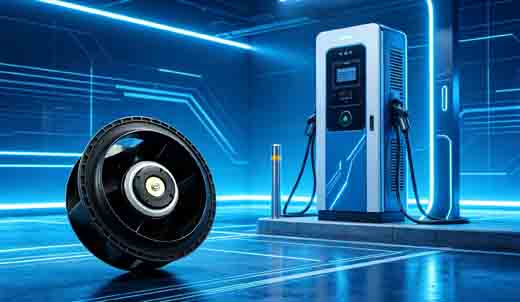
In the global race toward zero-emission transportation, Electric Vehicle (EV) charging infrastructure has evolved from simple AC wall boxes to complex, high-power DC fast-charging (DCFC) hubs. As power densities skyrocket—with some liquid-cooled superchargers reaching 480kW—the thermal management challenge has become the primary bottleneck for equipment reliability. Centrifugal fans have emerged as the critical "cooling heart" of these systems, offering the high static pressure necessary to drive air through dense power modules and intricate internal ducts.
I. The Thermal Crisis in High-Power DC Charging
Modern charging stations utilize power conversion modules based on IGBT (Insulated Gate Bipolar Transistor) or the newer SiC (Silicon Carbide) technology. While SiC increases efficiency, the heat dissipation per square millimeter remains immense. A typical 360kW station can generate several kilowatts of waste heat during peak operation.
The "Derating" Threat: When internal temperatures exceed safe thresholds (usually 70°C to 85°C), the station's control system triggers "Power Derating." This reduces charging speed to protect hardware, leading to longer wait times and frustrated users. Centrifugal fans prevent this by maintaining steady thermal equilibrium.
Why Static Pressure Matters
Unlike traditional axial fans that move air in a straight line with low resistance, centrifugal fans accelerate air radially. This design allows them to generate significant static pressure (reaching 500Pa to 1300Pa). This is essential in charging piles where air must penetrate dense heat sinks, dust filters, and curved internal baffles that would cause an axial fan to "stall."
II. Technical Advantages of EC and DC Centrifugal Fans
Selecting the right motor technology is as important as the fan's blade geometry. The industry is currently shifting toward EC (Electronically Commutated) technology for high-power applications.
| Technology | Standard DC Centrifugal | Advanced EC Centrifugal |
|---|---|---|
| Efficiency | Good (approx. 70-80%) | Excellent (up to 92%) |
| Control | PWM Speed Control | 0-10V / PWM / Modbus |
| Lifespan | 50,000+ Hours | 70,000 - 100,000 Hours |
| Power Source | 12V/24V/48V DC | 115V/230V AC (Direct) |
1. Intellectual Thermal Management
Modern fans are no longer "always on." By integrating PWM (Pulse Width Modulation) and FG (Frequency Generator) signals, centrifugal fans can communicate with the charging station's main controller. The fan speed ramps up only when the sensors detect a rise in module temperature, saving up to 15% in auxiliary power consumption.
III. Engineering for Harsh Outdoor Environments
Charging stations are often located in hostile environments: coastal areas with salt spray, deserts with fine sand, or regions with heavy rainfall. TKFAN engineers centrifugal fans with specialized protection protocols to ensure a 10-year service life.
- IP68 Potting Technology: We use vacuum potting and Parylene coatings to seal the PCB and motor windings, making them completely immune to water immersion and conductive dust.
- Corrosion Resistance: Metal impellers and housings undergo 500-hour salt spray testing to prevent structural failure in maritime climates.
- Extreme Temperature Resilience: Utilizing NMB dual ball bearings and low-temperature grease, our fans operate reliably from -40°C to +85°C, covering every climate from the Arctic to the Sahara.
IV. Selection Guide: Matching Fans to Station Power
Choosing a fan requires a balance between air volume (CFM) and static pressure (Pa). Below is a typical selection matrix for charging pile designers:
- AC Slow Chargers (7kW - 22kW): Focus on low noise. Compact DC centrifugal fans (120mm to 133mm) are ideal for light heat loads.
- Standard DC Chargers (60kW - 120kW): Requires high static pressure. 175mm to 190mm DC or EC fans are recommended to drive air through internal power modules.
- Ultra-Fast Superchargers (180kW - 480kW): High-power EC fans (225mm to 310mm) are necessary. These units often feature metal impellers to handle the high RPM required for massive heat dissipation.
V. Market Trends and Future Innovations
The market for EV charging station cooling is expected to grow by 22% CAGR through 2030. Key innovations include Low-Noise Bio-mimetic Blades, which reduce acoustic disturbance in residential charging hubs, and Predictive Maintenance Signals, where the fan can report its own health status (RD signal) to a central cloud server, allowing operators to replace fans before a failure occurs.
Frequently Asked Questions (FAQ)
Why is centrifugal static pressure better than axial airflow for chargers?
Axial fans provide high volume but low pressure. In a charging station, internal components are packed tightly, creating high "impedance." An axial fan's airflow would bounce back or stall. Centrifugal fans "compress" the air, giving it the force needed to pass through heat sinks and filters effectively.
What are the benefits of using EC (Electronically Commutated) fans over DC?
EC fans can connect directly to the station's AC power line without a separate power supply, reducing system complexity. Furthermore, they maintain higher efficiency across their entire speed range and offer longer lifespans due to reduced heat generation within the motor itself.
How does IP68 protection impact the fan's maintenance cycle?
IP68 protection virtually eliminates failures caused by moisture, sand, or salt corrosion. This reduces on-site maintenance visits by up to 40%, as the fan remains operational even in extreme weather conditions that would destroy standard industrial fans.
How can I reduce the noise of a high-power charging station at night?
By utilizing PWM speed control, the fans can run at 20-30% speed during night hours or low-load charging. This significantly drops the dBA levels, ensuring compliance with local urban noise ordinances while still providing sufficient trickle-cooling.
GET A QUOTE