

The Ultimate Guide to 12V DC Blower Fans for Electronic Device Cooling and Dust Removal
Discover why high-static pressure 12V DC centrifugal blowers are the premier choice for thermal management, equipment longevity, and efficient dust extraction in modern electronics.
In the world of modern electronics, overheating and dust accumulation represent two silent threats to system integrity. Whether dealing with high-performance gaming rigs, sealed industrial control cabinets, precision 3D printers, or life-saving medical equipment, thermal instability and particulate buildup can drastically degrade performance, trigger unexpected system crashes, and significantly shorten operational lifespans. Maintaining an optimal thermal environment is no longer just a technical preference—it is an absolute operational necessity.
Among the diverse cooling methodologies available on the market today, the 12V DC blower fan (specifically the centrifugal configuration) has emerged as the industry benchmark solution. Combining a compact form factor with superior static pressure, low noise thresholds, and remarkable energy efficiency, these thermal devices solve the inherent limitations of traditional axial fans. This comprehensive guide details why 12V DC blowers are the premier choice for electronic cooling and dust removal, the critical engineering metrics to analyze during selection, and the proactive maintenance steps required to achieve up to 70,000 hours of continuous service.
1. Why 12V DC Blower Fans Are the Ideal Choice for Electronics
Traditional axial cooling fans excel at shifting large volumes of unrestricted air (high airflow, low static pressure). However, when confronted with dense internal environments—such as tightly packed circuit boards, complex ductwork, or restrictive heatsink fins—axial fans experience severe airflow restriction. This is where the 12V DC centrifugal blower excels.
Compact Dimensions with High Versatility
Engineering modern electronics requires maximizing spatial efficiency. 12V DC blowers are manufactured in highly adaptable micro-to-medium form factors, with standardized outer dimensions including 40mm, 50mm, 60mm, 75mm, 97mm, and 120mm, and ultra-thin profiles ranging from 14mm to 33mm. Utilizing a 12V DC voltage architecture ensures native compatibility across consumer electronics, automotive electrical systems, solar-powered arrays, and industrial automated controls, eliminating the necessity for heavy AC-to-DC step-down transformers.
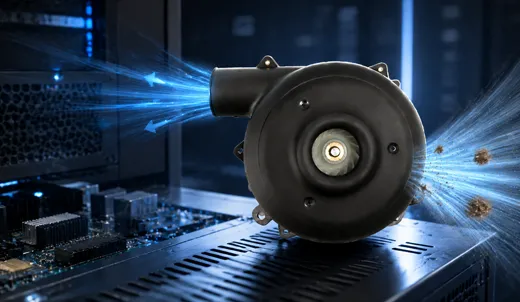 Figure 1: High-efficiency 12V DC centrifugal blower fan optimized for confined spaces.
Centrifugal High Static Pressure Dynamics
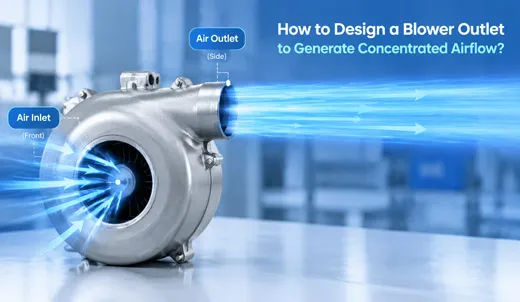
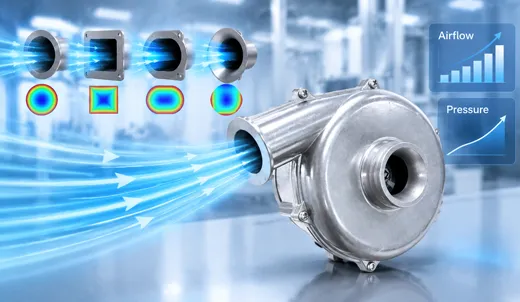
Unlike axial models, a centrifugal blower draws ambient air into its center hub, accelerates it through a rapidly spinning curved impeller wheel, and forces it out at a 90-degree angle through a concentrated exhaust port. This thermodynamic manipulation yields focused, high-velocity jet streams capable of generating static pressures up to 5.5 kPa. This offers a dual benefit:
- Precision Spot Cooling: The focused air stream easily penetrates dense CPU/GPU heatsinks and power modules, mitigating localized thermal pockets that conventional fans cannot reach.
- Active Dust Eradication: The concentrated velocity acts as a continuous mechanical broom, forcefully dislodging microscopic dust particles and lint from delicate PCB components before they form a thermal insulating layer.
Brushless DC (BLDC) Efficiency and Silence
Premium 12V blowers incorporate advanced **Brushless DC (BLDC) motor technology**. By swapping out mechanical carbon brushes for electronic commutation, these motors cut energy consumption by 30% to 50% compared to traditional brushed or AC variants. When paired with aerodynamic impellers and precision-engineered dual ball bearings, operational acoustic output can drop as low as 24 dBA, making them well-suited for noise-sensitive settings like medical laboratories and corporate workspaces.
2. Engineering Parameters for 12V DC Blower Selection
Selecting the optimal blower model requires aligning mechanical system constraints with the blower's intrinsic electrical and aerodynamic performance metrics. Key specifications include:
| Blower Frame Size | Airflow Range (CFM) | Static Pressure Profile | Primary Target Applications |
|---|---|---|---|
| 40mm (e.g., 4010 / 4020) | 2 to 5 CFM | Low to Medium | Single-board computers (Raspberry Pi), network routers, micro 3D printer hotends. |
| 50mm (e.g., 5015) | 4 to 8 CFM | Medium Balanced | Desktop 3D printers (part cooling), small-scale industrial control interfaces. |
| 60mm (e.g., 6025) | 8 to 15 CFM | Medium to High | Gaming consoles, compact power supply units (PSUs), telecommunication switches. |
| 75mm (e.g., 7530) | 10 to 25 CFM | High Static Pressure | Medical ventilators, CPAP machines, heavy-duty server rack nodes. |
| 97mm (e.g., 9733) | 20 to 45 CFM | Ultra High Peak | Large industrial electrical enclosures, automotive battery thermal management (BMS). |
Bearing Architecture: Ball vs. Sleeve
The operational lifespan of a cooling blower is fundamentally dictated by its internal bearing system:
- Sleeve Bearings: Cost-efficient and remarkably quiet at low rotational speeds. However, they suffer from oil evaporation over time and have a shorter operational lifespan (approx. 10,000 to 25,000 hours), restricting their use to light-duty consumer electronics.
- Dual Ball Bearings: Highly durable with a functional lifecycle extending past 50,000 to 70,000 hours at 40°C. They can operate in any physical mounting orientation, handle elevated ambient temperatures, and deliver highly reliable performance for mission-critical industrial applications.
Pulse-Width Modulation (PWM) and Intelligent Control
Modern thermal sub-systems rely on intelligent feedback loops. Choosing a 12V blower equipped with PWM (Pulse-Width Modulation) speed control allows external motherboard controllers to dynamically scale the impeller speed from 0% to 100% based on live thermal probe telemetry. Furthermore, integrated Frequency Generator (FG) tachometer signals monitor real-time RPM, allowing system diagnostics to quickly detect an impeller stall and prevent thermal runaway.
3. Mainstream Application Scenarios for 12V DC Centrifugal Blowers
3D Printing Precision
In fused deposition modeling (FDM), 12V 5015 blowers are the gold standard for part cooling. Delivering focused air at the nozzle layer helps minimize filament sagging, prevents layer separation, and keeps overhangs printing crisply.
Industrial Control Enclosures
Heavy duty 97mm configurations drive hot exhaust air out of sealed factory electrical cabinets. Their high-pressure performance ensures that ventilation streams continue moving even when high-efficiency particulate air (HEPA) filters are in place.
Medical Ventilators & CPAP
Healthcare systems require continuous reliability. Specialized low-noise BLDC blowers supply clean, continuous air pressure to respiratory units, striking the right balance between responsive speed adjustments and exceptionally quiet operation.
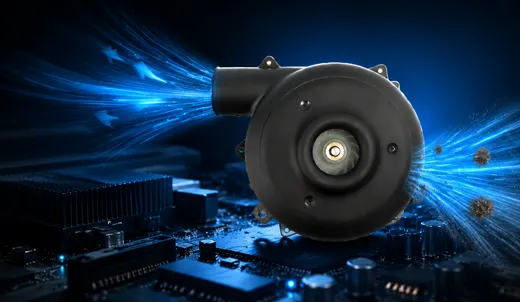
Figure 2: Multi-industry distribution of 12V DC centrifugal blowers and high-performance cooling fans.
4. Preventative Maintenance Protocols for Long-Term Reliability
Even an industrial-grade IP55-rated blower fan requires proper maintenance to ensure it delivers its full operational lifespan. Implement the following engineering practices to preserve thermal and dust-removal efficiency:
- Routine Particulate Clearance: Establish a 3-to-6-month cleaning cycle using compressed air canisters or ESD-safe vacuum systems to purge accumulated debris from the intake hub and internal curved impellers. Heavy debris imbalances the blade assembly, which increases bearing wear and acoustic noise.
- Acoustic and Vibrational Monitoring: Listen closely for sudden scraping sounds or high-frequency vibrations. These are clear indicators of structural bearing fatigue, signaling that a proactive component replacement is needed before the fan stops entirely.
- Voltage Rail Regulation: Maintain DC input tolerances within ±10% of the nominal 12V rating. Prolonged over-voltage stresses the internal commutation circuit, while under-voltage drops static pressure below optimal design levels.
- Obstruction-Free Airflow Ducts: Design internal layouts to keep intake ports clear. Constricted intake paths force the blower to run at a high vacuum state, which can increase motor heat and accelerate aging.
Technical FAQ: 12V DC Blower Cooling Systems
Q1: What is the primary difference between an axial cooling fan and a centrifugal blower?
Axial fans expel air parallel to the blade rotation axis, offering high volume but low static pressure, which is best for broad ventilation. Centrifugal blowers intake air centrally and expel it perpendicular to the intake path at a 90-degree angle. This creates high static pressure that allows air streams to penetrate tight spaces, dense heat sinks, and restrictive duct networks.
Q2: Can I control the speed of a 12V DC blower using a 5V input signal?
Reducing input voltage below nominal specs (voltage dimming) will lower the blower speed, but drops below the minimum startup voltage (typically around 6V to 7V for a 12V motor) may cause it to stall. For precise, reliable speed adjustments, use a 4-pin PWM-enabled 12V blower. This keeps the constant 12V power supply intact while using a separate 5V pulse signal to manage speed safely.
Q3: What ingress protection (IP) rating is recommended for severe industrial dust environments?
For standard clean-room or indoor computing, an IP20 configuration is completely sufficient. However, if the hardware is deployed in severe industrial environments containing metal shavings, particulate dust, or ambient moisture splash, specify an **IP55 or IP68 encapsulated model** to shield critical motor parts from premature failure.
Q4: How does high static pressure help with long-term dust removal?
Dust accumulates on surfaces when the local air velocity drops, allowing airborne particles to settle. A high-static-pressure blower delivers a fast, concentrated stream of air that overcomes internal airflow resistance. This maintains high air velocity across complex electronic assemblies, continually clearing away loose particulates before they bake onto circuit boards.