

Comprehensive Analysis: Core Cost Drivers of Industrial DC Cooling Fans and Blowers
When designing complex thermal management systems, evaluating the cost structure of direct current components is a vital engineering and procurement requirement. Discover how motor configurations, bearing architectures, speed curves, driver electronics, and environmental ingress protection ratings directly dictate DC cooling fan cost profiles and long-term asset reliability.
Direct Current (DC) cooling fans and centrifugal blowers serve as primary, indispensable thermal management mechanisms across a wide array of high-stakes technology sectors. From high-density server architectures inside enterprise AI data centers to precision automotive thermal paths within electric vehicles (EV), advanced industrial automation control bays, and telecommunication hardware enclosures, the global reliance on efficient air movement hardware is expanding rapidly. Leading market research frameworks project that the international energy-saving, highly reliable brushless DC fan market will grow at a strong Compound Annual Growth Rate (CAGR) of 7.2% through 2030.
For procurement specialists, component sourcing agents, systems design engineers, and industrial plant managers, understanding the exact technical breakdown of DC cooling fan cost structures is essential. Industrial air moving components are not basic commodities with fixed pricing. Instead, the final commercial quotation is an outcome of specific, finely balanced design variables. Sourcing parameters dictate that pricing trends are driven by six core variables: internal motor engineering, bearing operational design, maximum rotational speed (RPM), driver circuit intelligence, IP ingress environmental protection ratings, and custom mechanical adjustments.
This technical analysis breaks down each core variable, showing how specific performance requirements impact your initial Bill of Materials (BOM) cost and subsequent Total Cost of Ownership (TCO). By mastering these underlying factors, engineering groups can make smart purchasing choices, balance performance goals with budget limits, and ensure long-term stability without overpaying for unneeded features.
1. Motor Architecture: The Primary Foundation of Fan Build Costs
The internal electric motor is the core component and the most capital-intensive element of any DC cooling fan configuration, typically commanding 30% to 40% of the entire product material cost. The choice of motor topology determines a fan's baseline thermodynamic efficiency, operating sound levels, running lifespan, and initial wholesale cost.
1.1 Brushed DC Motors (Economy Grade Framework)
Brushed DC motors rely on physical carbon brushes and a mechanical commutator to change polarities. While exceptionally cost-effective to manufacture initially, the continuous physical friction inevitably leads to brush degradation and mechanical failure.
- Wholesale Pricing Range: $1.50 to $3.00 USD (based on high-volume production agreements).
- Operational Lifespan: 1,000 to 3,000 hours maximum before brush wear causes motor failure.
- Thermodynamic Efficiency: 75% to 80% (vulnerable to structural heat losses via constant brush friction).
- Target Workloads: Low-cost consumer electronics, promotional merchandise, short-lifecycle novelty goods, and disposable appliances.
1.2 Brushless DC (BLDC) Motors (Industrial Mainstream Infrastructure)
By replacing mechanical brushes with an electronic PCB commutation system and high-performance permanent magnets (such as barium ferrites or advanced Neodymium-Iron-Boron alternatives), brushless DC cooling fans eliminate high-wear friction points, greatly increasing system reliability.
- Wholesale Pricing Range: $3.00 to $8.00 USD (representing a 2x to 3x increase in initial component cost over brushed varieties).
- Operational Lifespan: 50,000+ continuous hours under full operating duty cycles.
- Thermodynamic Efficiency: 80% to 85%+ with minimal self-generated heat.
- Target Workloads: High-density IT servers, network telecom base stations, medical imaging systems, and electric vehicle cooling.
1.3 Field-Oriented Control (FOC) & Permanent Magnet Synchronous Motors (Premium Grade)
For high-demand applications like enterprise AI supercomputing arrays, aerospace avionics, and autonomous automotive compute clusters, cooling fan manufacturers use Permanent Magnet Synchronous Motors (PMSM) managed by complex sinusoidal Field-Oriented Control (FOC) firmware.
- Wholesale Pricing Range: $8.00 to $15.00+ USD per unit.
- Core Engineering Value: Complete conformance with international IE5 ultra-premium efficiency standards, near-perfect rotational velocity accuracy, ultra-low electrical noise, and exceptional resilience to intense thermal shocks.
Procurement Takeaway: Upgrading an engineering specification from a brushed architecture to a brushless core increases upfront unit acquisition costs by 100% to 200%. However, this investment yields a massive 15x to 20x extension in component working lifespan, lowering overall lifecycle costs by eliminating field-service maintenance.
2. Bearing Systems: Balancing Lifespan, Noise Levels, and Thermal Limits
The internal bearing configuration serves as the primary mechanical anchor of the rotating assembly, typically accounting for 15% to 25% of the overall fan build cost. The choice of bearing directly dictates how a fan maintains its acoustic profile and resists mechanical wear over time, especially when exposed to elevated operating temperatures.
2.1 Sleeve Bearings (Budget-Focused, High Evaporation Risk)
Sleeve bearings use a simple, oil-impregnated porous metal sleeve around the rotor shaft. While highly cost-effective, they are prone to rapid lubricant evaporation when local ambient temperatures cross 40°C. This loss of lubrication leads to friction spikes, balancing shifts, and eventual rotor lockup.
- Average Pricing: $0.50 to $1.00 USD.
- L10 Lifetime Expectancy: 20,000 to 30,000 hours at a controlled 40°C threshold.
- Acoustic Profile: 25 to 35 dBA (Note: Noise levels increase over time as physical mechanical wear develops).
2.2 Dual Ball Bearings (Heavy-Duty Industrial Benchmark)
Utilizing two rows of precision-ground steel balls within a structured race, dual ball bearings drastically lower mechanical friction. They operate reliably at any installation angle (vertical, horizontal, or skewed) and maintain structural integrity inside elevated environments up to 70°C, making them an industry favorite for rugged hardware.
- Average Pricing: $1.00 to $3.00 USD (representing a 2x to 3x premium over sleeve models).
- L10 Lifetime Expectancy: 50,000 to 70,000 hours, even when continuously operating inside severe 70°C environments.
- Acoustic Profile: 22 to 28 dBA (Highly stable across the fan's entire operational lifecycle).
2.3 Hydraulic and Magnetic Levitation (MagLev) Bearings (Premium Silence Solutions)
Hydraulic designs feature dynamic fluid pathways that create a continuous, pressurized oil film to eliminate metal-on-metal contact. True MagLev layouts go a step further, using calibrated magnetic fields to suspend the rotor shaft entirely. This eliminates physical friction points, minimizing mechanical wear and providing exceptionally quiet operation over the fan's lifecycle.
- Average Pricing: $3.00 to $10.00 USD (High-tier premium pricing tier).
- L10 Lifetime Expectancy: 80,000 to 100,000+ hours under continuous operation.
Acoustic Profile: 18 to 22 dBA (Excellent acoustic performance for noise-sensitive installations).
3. Rotational Velocity (RPM): Balancing Airflow Delivery and Structural Rigidity
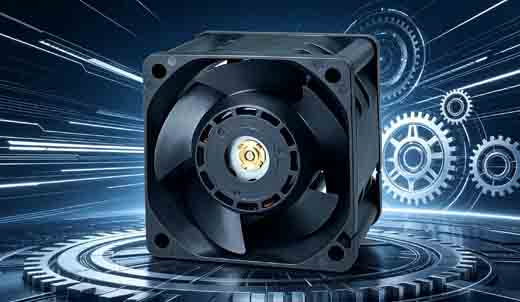
A fan's rated RPM directly drives its volumetric displacement—measured in Cubic Feet per Minute (CFM)—and its static pressure capabilities. Scaling up rotational velocity requires increased motor torque, precise balancing adjustments, and reinforced blade geometries, all of which raise manufacturing costs.
For instance, a standard 120mm size low-velocity fan (1,000 to 2,000 RPM) typically costs between $2.00 and $5.00 USD. These fans deliver a modest 30 to 50 CFM profile at low acoustic levels (22 to 28 dBA), making them ideal for everyday consumer electronics and office devices.
Stepping up to mid-velocity configurations (2,000 to 4,000 RPM) shifts wholesale pricing to the $5.00 to $10.00 USD tier. These models balance cost and performance, moving 50 to 80 CFM to effectively cool automated factory cabinets, commercial power supplies, and building HVAC systems.
At the top of the performance spectrum, high-velocity assemblies (4,000 to 10,000+ RPM) command a premium, ranging from $10.00 to $25.00+ USD per unit. To handle extreme centripetal forces without warping, their impellers are molded from dense, glass-fiber-reinforced polybutylene terephthalate (PBT). These high-performance components are essential for pushing air through the tight spaces found in compact enterprise servers and industrial blowers.
4. Driving Circuitry: From Simple Constant Voltage to Smart Telemetry
The internal Printed Circuit Board Assembly (PCBA) and its surface-mounted microcontroller serve as the control center of modern DC cooling fans. Simple, fixed-voltage driving configurations are highly economical but limit systemic efficiency and diagnostic options.
4.1 Constant Fixed-Speed Drives (Basic Cost Optimization)
Featuring straightforward diode and regulator circuits, these basic layouts run the motor at a set speed based on the supplied input voltage. They cost between $0.50 and $1.50 USD but do not include locked-rotor or thermal protection circuits.
4.2 PWM Speed Regulation Arrays (The Modern Industrial Standard)
Equipped with a 4-wire termination design (Power, Ground, Tachometer pulse output, and Pulse Width Modulation input), these intelligent circuits allow system controllers to adjust fan speeds from 0% to 100% based on actual thermal demand. Priced between $1.50 and $4.00 USD, they feature standard protection mechanisms like automatic restart logic, overvoltage protection, and current-limiting features.
4.3 Premium Network-Connected Smart ICs (Advanced Telecom Architecture)
By using advanced System-on-Chip (SoC) microcontrollers that support communication protocols like I2C, SMBus, or Modbus, these high-end assemblies (priced from $4.00 to $10.00 USD) provide real-time diagnostic reporting, closed-loop speed tracking, and automated failure predictions for industrial Internet of Things (IIoT) factory ecosystems.
5. IP Environmental Protection: Shielding Components from Dust and Moisture
Deploying cooling fans outdoors or in demanding manufacturing environments requires dedicated environmental protection. Higher Ingress Protection (IP) ratings depend on advanced sealing processes, specialized conformal coatings, and premium materials, which introduce a predictable cost premium to the core product.
- IP20 to IP44 Ratings (Standard Controlled Environments): Provides basic protection against typical dust particles and light, multi-directional water spray. This level of protection adds minimal overhead (+$0.00 to $2.00 USD premium per unit).
- IP54 to IP65 Ratings (Industrial Dust & Water Jet Defiance): Requires precision silicone seals along structural housing joints and a uniform layer of protective conformal coating across all PCBA traces. This adds a +$2.00 to $5.00 USD premium, making these fans well-suited for outdoor telecom installations and food processing environments.
- IP67 to IP68 Ratings (Submersible Marine-Grade Heavy Protection): Employs a complete vacuum encapsulation process that coats internal electronics in high-grade optical epoxy resin, paired with stainless steel structural fasteners and fully waterproofed electrical connections. This premium environmental protection adds a +$5.00 to $15.00+ USD premium, delivering a resilient cooling asset that operates reliably under water or in highly corrosive atmospheres.
6. Engineering Customization: Custom-Tailoring Fans for Specific Space and Electrical Design Needs
When standard catalog cooling solutions fall short of complex system layouts, engineering customization introduces a variable layer of cost. The final unit price depends on the mechanical adjustments needed, specialized electrical engineering, upfront tooling investments, and total volume commitments.
6.1 Mechanical Alterations
Designing non-standard frame scales (e.g., intermediate dimensions like 50x50x15mm) requires dedicated injection mold adjustments, with custom tooling costs ranging from $500 to $5,000+ USD. Simpler structural customizations, such as specialized mounting brackets, custom flange styles, unique wiring lengths, or specific terminal connector housings (like Molex or JST), add nominal piece-price premiums.
6.2 Electrical & Intelligence Custom Tuning
Modifying a fan to operate on uncommon input voltages (such as high-voltage 48V DC, 72V DC, or 110V DC) requires custom motor windings and upgraded capacitor ratings on the driving circuit, which adds a premium to the piece price. Custom performance scaling—such as tweaking blade geometry, programming custom dual-speed loops, or configuring automated alarm telemetry signals (e.g., Rotation Detector / RD outputs)—typically adds a modest per-unit premium.
6.3 Volume and Lead Time Economics
High-volume production runs (10,000+ units) effectively amortize upfront NRE (Non-Recurring Engineering) and tooling investments, reducing piece costs by up to 50% compared to short runs. For low-volume orders under 1,000 units, buyers must absorb the unamortized tooling costs, which increases the per-unit price. Additionally, expedited production windows (2 to 4 weeks) require factory shift adjustments and air-freight logistics, which can add a 20% to 50% surcharge to the order total.
Comparative Matrix: Overview of DC Cooling Fan Technical Specs
| Technical Parameter | Economy Class Solution | Industrial Workhorse Grade | Ultra-Premium Infrastructure |
|---|---|---|---|
| Motor Topology | Brushed DC Layout | Standard Brushless DC (BLDC) | FOC Sinusoidal / PMSM Motor |
| Bearing Integration | Sleeve / Porous Bushing | Precision Dual Ball Array | Fluid Hydraulic / Sealed MagLev |
| Typical Airflow Level | Low (5 to 50 CFM) | Moderate to High (50 to 200 CFM) | Extreme Load (200 to 500+ CFM) |
| Drive Intelligence | Simple Fixed-Voltage Loop | 4-Wire Speed Controlled PWM | IIoT Smart Networked Bus ICs |
| Environmental Shield | IP20 Baseline Protection | IP54 / IP65 Conformal Coat | IP68 Total Vacuum Resin Seal |
Technical FAQ: Sourcing & Engineering Analysis
Q1: Why do dual ball bearing DC fans carry a price premium over sleeve bearing models?
A1: Dual ball bearings require precision-machined internal steel spheres, inner/outer structural races, and specialized retaining cages, all built to demanding tolerances. Sleeve bearings, by contrast, use simpler sintered metal bushings impregnated with oil. The extra material costs and manufacturing precision required for dual ball configurations provide exceptional multi-axis orientation freedom, excellent resistance to high temperatures, and a working lifespan that is 2x to 3x longer than sleeve alternatives.
Q2: How does a 4-wire PWM driving circuit contribute to lowering long-term system TCO?
A2: While a 4-wire PWM-driven cooling fan carries a higher initial purchase price compared to a simple fixed-speed 2-wire model, it enables dynamic speed control tailored to real-time thermal loads. By avoiding continuous full-speed operation, the fan lowers cumulative energy consumption by 20% to 40%, slows the build-up of internal dust, and reduces bearing wear. This extended components lifespan leads to lower maintenance overhead and fewer on-site replacement cycles.
Q3: What are the engineering trade-offs when scaling up a DC cooling fan to high operational RPMs?
A3: Increasing the rotational speed scales volumetric airflow linearly and static pressure quadratically. However, it requires a high-torque motor assembly and glass-fiber reinforced impeller blades to prevent structural distortion under centripetal stress. The primary trade-off is acoustic performance: high-velocity airflow increases air turbulence, which can raise system noise by 10 to 15 dB and may require additional sound insulation modifications.
Q4: Does upgrading to an IP68 waterproof configuration degrade a fan's volumetric airflow performance?
A4: Standard IP68 vacuum encapsulation processes apply a specialized epoxy compound that seals the stator assembly and internal PCBA. Because this protective layer is applied internally, it does not alter the aerodynamic profile of the external impeller blades or the overall outer dimensions. As a result, the fan retains its original airflow, static pressure, and velocity specifications while gaining robust protection against submersion and environmental ingress.
GET A QUOTE