

Ultimate Guide: How to Choose Between 12V, 24V, and 48V DC Blowers
When designing thermal management systems, selecting the optimal voltage input for your DC blower fan is a critical engineering decision. Whether it is for automotive components, industrial automation, medical equipment, or 5G telecom shelters, understanding the performance trade-offs between 12V, 24V, and 48V DC centrifugal blowers ensures peak efficiency, long-term reliability, and cost-effectiveness.
Fundamentals of DC Blowers and Voltage Metrics
A DC blower (often referred to as a DC centrifugal blower fan or squirrel cage fan) utilizes direct current to drive an internal impeller. Unlike standard axial fans that move air parallel to the blade axis, blowers intake air centrally and expel it at a 90-degree angle, generating significantly higher static pressure. This makes them indispensable for ducted systems, tightly packed server enclosures, and high-impedance cooling pathways.
In DC motor engineering, input voltage acts as the fundamental driving electromotive force. It directly controls three interconnected technical parameters:
- Rotational Speed (RPM): Generally, higher nominal voltages allow for higher motor RPM ratings, directly multiplying total airflow (CFM) and static pressure capabilities.
- Current Draw (Amperes): According to Ohm's Law and basic power equations, for a fixed power output, increasing the voltage proportionately decreases the operating current.
Thermal Efficiency: Reduced current directly limits localized copper losses and heat dissipation within the motor coils, boosting overall system efficiency.
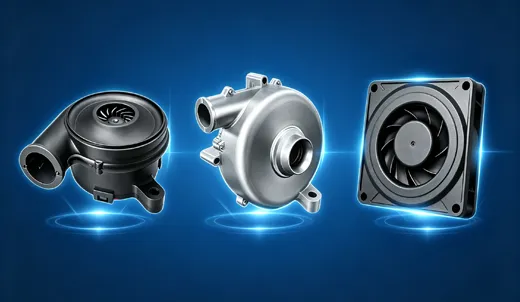
12V DC Blowers: Versatile and Cost-Effective Thermal Solution
The 12V DC blower represents the most ubiquitous voltage standard in consumer electronics and small-scale automotive applications. Due to its deeply established ecosystem, it is the go-to solution for low-to-medium power cooling configurations where physical space is minimal and budget optimization is paramount.
Key Technical Attributes of 12V Systems
- Universal Power Compatibility: Since 12V DC grids are native to ATX PC power supplies, standard automotive batteries, and generic consumer AC-DC wall adapters, integration requires zero auxiliary step-down buck converters.
- Compact Form Factor: Typically optimized for localized heat dissipation, 12V micro-blowers feature low-profile architectures that fit seamlessly inside tight enclosures.
- Economic Procurement: Massive manufacturing scale lowers individual unit costs, minimizing initial BOM (Bill of Materials) expenditure.
Primary Applications
12V DC blowers are extensively integrated into desktop PC chassis, 3D printers, household air purifiers, humidifiers, automotive dashboard climate control, and portable battery-powered outdoor gear.
24V DC Blowers: The Industrial Workhorse for Balanced Power and Efficiency
When scaling up to commercial machinery, the 24V DC blower fan takes center stage. Striking an ideal equilibrium between raw pneumatic output, operational energy efficiency, and electrical safety safety thresholds, 24V architectures dominate the modern industrial automation landscape.
The 24V Technical Advantage
At equivalent power ratings, a 24V blower draws exactly half the current of a 12V model. Utilizing the Joule heating formula for line power loss:
P_loss = I² × R
Cutting the current ($I$) by 50% slashes distribution line power losses by a massive 75%. This minimizes voltage drop along supply cables and drastically reduces heat generation within internal control panels.
Industrial Safety and Target Sectors
24V DC falls well within the Safety Extra-Low Voltage (SELV) range defined by international frameworks like IEC 61140 and OSHA. This guarantees near-zero risks of electrical shock to operators. Key industries include CNC machine ventilation, PLC enclosure cooling, commercial HVAC dampeners, and medical devices such as CPAP machines and ventilators requiring strict low-voltage compliance.
48V DC Blowers: Premium High-Capacity Cooling for Heavy-Duty Infrastructure
For high-density, mission-critical environments, the 48V DC centrifugal blower stands unmatched. Delivering ultimate volumetric airflow and extreme static pressure capabilities, 48V motors represent the pinnacle of heavy-duty thermal management engineering.
Maximum Performance with Zero Compromise
- Extreme Air Moving Capacity: Capable of delivering airflows exceeding 200–500 CFM alongside immense static pressure to penetrate ultra-dense server grids or industrial filter mediums.
- Minimal Wire Guage Requirements: Drawing only 25% of the current of a 12V system, 48V systems can implement much thinner power delivery cables, drastically lowering copper wiring costs and overall system weight.
- Telecom-Grade EMI Resistance: A nominal -48V DC power rail is the historic, robust standard across global telecommunications infrastructures, praised for its excellent noise immunity and low electrolytic corrosion risk.
Heavy Industrial and Enterprise Deployment
48V fans are standard hardware inside high-density enterprise server racks, 4G/5G macro cell base stations, large solar inverter heat sinks, commercial EV charging stations, and industrial welding machinery.
Comparative Matrix: 12V vs. 24V vs. 48V DC Blowers
| Technical Specification | 12V DC Blower | 24V DC Blower | 48V DC Blower |
|---|---|---|---|
| Airflow Range (CFM) | Low to Medium (5 - 50 CFM) | Medium to High (50 - 200 CFM) | Extreme (200 - 500+ CFM) |
| Current Loss Factor (I²R) | High (Baseline) | Reduced by 75% | Reduced by ~93.7% |
| Maximum Cable Run | Short (< 5 meters) | Moderate (5 - 20 meters) | Long (20+ meters) |
| Primary Ecosystem | PCs, Consumer Electronics | Industrial Automation, Medical | Telecom, Data Centers, EV |
| BOM Cost Per Unit | Lowest | Moderate | Highest |
Top 5 Factors to Evaluate During Voltage Selection
1. System Power Source Alignment
Always match the blower’s nominal voltage with your system's master power distribution unit (PDU). Forcing a 12V fan into a 24V supply loop will quickly burn out the motor coils due to overcurrent. Conversely, powering a 48V blower fan via a 12V line results in startup failure or severely degraded RPM.
2. Static Pressure and Resistance Profiles
If your air track forces air through HEPA filters, intricate heat exchangers, or convoluted ducting networks, your system exhibits high aerodynamic impedance. 24V and 48V brush/brushless motor configurations generate the robust torque curves required to sustain high velocity under restrictive load parameters.
3. Scale of the Centralized Fan Array
For multi-fan setups running in parallel over broad floor layouts, opting for 48V or 24V infrastructure significantly downsizes copper wiring costs. Thinner wires mean lighter, more organized routing and vastly reduced deployment costs.
4. Long-Term TCO (Total Cost of Ownership) Optimization
While 12V solutions minimize upfront capital expenditure, they draw extensive power under demanding duty cycles. For data facilities operating 24/7/365, deploying highly efficient 48V systems reduces operational energy costs by 40% to 60% over a 5-year lifecycle, offsetting the initial purchase premium.
5. Regulatory and Safety Code Adherence
In the medical and food processing sectors, strict limits govern operational line voltages to eliminate fire hazards and leakage risks. Verify that your selection aligns with target region certifications (such as CE, UL, RoHS, or TUV) before proceeding with large-scale deployment.
Technical FAQ: DC Centrifugal Blowers Selection
Q1: Can I safely speed-control a 24V or 48V DC blower using PWM inputs?
Yes, most premium 24V and 48V industrial DC blowers come equipped with a dedicated 4-wire interface supporting PWM (Pulse Width Modulation) signal inputs. This allows intelligent system microcontrollers to step-lessly scale blower speed dynamically based on real-time temperature feedback, reducing idle acoustic noise and energy waste.
Q2: What happens if the supply voltage drops slightly below the blower’s nominal rating?
DC blowers typically specify an input voltage range (e.g., 18V–28V for a nominal 24V unit). Operating slightly below nominal voltage causes a drop in motor torque and rotational speed, which lowers both airflow and static pressure. Dropping below the minimum cutoff threshold will cause the motor stalling or failure to initiate rotation.
Q3: Why are 48V DC blowers preferred in telecom base stations over standard AC fans?
Telecom systems rely on central battery backups during grid outages. Because 48V DC power is directly available from backup battery arrays, 48V DC blowers can continue running during power failures without needing inefficient DC-to-AC power inverters, ensuring uninterruptible cooling for critical infrastructure.
Q4: Are 12V DC blowers inherently louder than 48V versions?
Acoustic noise (dBA) is primarily dictated by blade design, housing geometry, and operational RPM rather than voltage itself. However, because 48V blowers are engineered for high-performance and run at much higher peak RPMs, they often produce higher audible noise levels than low-power consumer 12V blowers under full load conditions.
GET A QUOTE