

The Ultimate Industrial Blower Procurement Guide: From Technical Specifications to Mass Production
Maximize efficiency and minimize downstream downtime. This comprehensive B2B sourcing guide outlines strategic technical parameters, manufacturer qualification matrices, and performance verification protocols for heavy-duty industrial blowers and thermal cooling fans.
Executive Summary: Heavy-duty industrial blowers are the core components of modern manufacturing, pneumatic conveying, environmental filtration, wastewater aeration, and complex HVAC processes. Selecting substandard equipment or rushing straight to bulk sourcing without stringent validation can cause systemic energy losses, catastrophic production downtime, emissions non-compliance, and compounding maintenance costs. This procurement playbook establishes a standardized framework for supply chain managers and mechanical engineers to confidently source high-performance industrial blowers.
1. Pre-Procurement: Defining Operational Environments & Core Technical Parameters
Eliminating over 80% of downstream post-sale disputes begins with accurate calculations prior to engaging an industrial cooling fan manufacturer. Because industrial blowers operate as highly customized engineering systems, precise application matching overrides superficial low-cost procurement strategies.
1.1 Critical Operational Conditions
- Application Scenarios: Explicitly define whether the machinery is intended for positive-pressure pneumatic conveying, negative-pressure vacuum extraction, fine-bubble wastewater aeration, or standard workspace ventilation.
- Gas Stream Medium Properties: Isolate the exact attributes of the moving gas. Standard air requires basic structural configurations, whereas corrosive chemical streams (e.g., $H_2S$), extreme high-temperature atmospheres (up to 450°C), or particulate-heavy processing streams (particulate diameter ≤ 0.5 mm) dictate premium structural upgrades.
- Duty Cycle Requirements: Distinguish between continuous 24/7/365 uninterrupted operations (where motor energy efficiency dominates Total Cost of Ownership) and intermittent, on-demand cycles.
Environmental Exposure Constraints: Isolate indoor/outdoor structural risks, localized ambient temperature windows (-20°C to 60°C), relative humidity peaks, and strict explosive atmosphere ratings (such as ATEX Zone 1 / Zone 2 or Flameproof Ex d IIB T4 regulations).
1.2 Rigorous Engineering Specifications
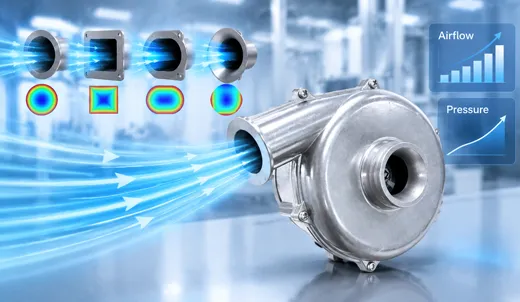
- Airflow Volume (CFM or m³/h): The volumetric measure of gas moved per unit of time. Procurement agents must budget a 5% to 10% safety margin to overcome unexpected system resistance variations. Over-specifying this value introduces an immediate 8% to 15% energy cost penalty.
- Static Pressure (Pa or kPa): The force required to overcome cumulative ductwork friction, high-efficiency particulate air (HEPA) filters, and downstream layout impediments.
- Motor Nominal Power (kW): Must structurally align with specific airflow curves. Sourcing premium IE4 or IE5 ultra-high-efficiency motors yields immense dividends, drastically lowering long-term electricity overheads.
- Structural Housing Materials: • Galvanized Steel: Economical alternative optimized for clean, low-temperature, low-humidity air. • SUS304 / SUS316L Stainless Steel: Critical for acid-base environments, chemical exhaust, and sterile food processing plants. • Heavy-Duty Cast Iron: Provides exceptional rigid structural dampening for high-pressure Roots blowers.
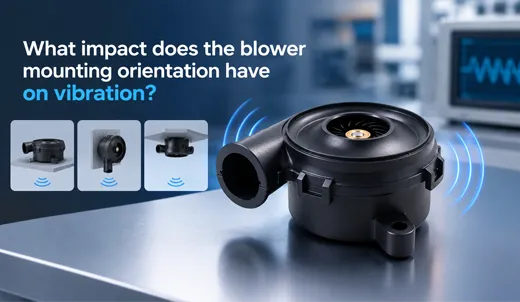
- Acoustic & Vibration Limits: Specify an operational footprint restriction of ≤ 85 dB(A) at 1 meter and vibration levels ≤ 4.5 mm/s to protect plant workforce safety and maintain regional compliance.
- Energy Efficiency Directives: Products must strictly comply with eco-design benchmarks such as China’s GB 28381-2026 and global ISO 5389 standards. Selecting a certified Tier-1 high-efficiency model offers a 20% to 35% reduction in power use compared to baseline Tier-3 alternatives.
1.3 Industrial Blower Classification and Selection Matrix
| Blower Typology | Operating Principles | Primary Applications | Engineering Advantages |
|---|---|---|---|
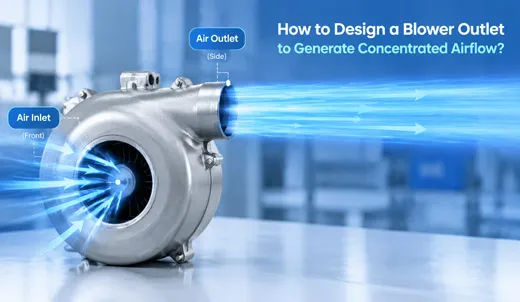
| Centrifugal Blower | High-speed impellers transform kinetic energy into static pressure via centrifugal force. | HVAC air conditioning, industrial dust collection, localized ventilation, low-resistance air moving. | High aerodynamic efficiency, low acoustic signature, compact physical footprint. |
| Roots Blower (Positive Displacement) | Counter-rotating twin or tri-lobe impellers trap and discharge precise fixed gas volumes. | Dense pneumatic material conveying, industrial wastewater aeration tanks, chemical processing. | Maintains ultra-stable volumetric airflow rates even under severe downstream system pressure fluctuations. |
| Regenerative / Ring Blower | Non-contacting impellers accelerate gas within a circular ring via continuous vortex generation. | Medium-pressure processing machinery, commercial printing lines, industrial packaging lines. | 100% oil-free gas delivery, space-saving layout, minimal mechanical maintenance. |
| Maglev / Air-Bearing Turbo Blower | Direct-drive high-speed permanent magnet motors operating completely without mechanical friction. | Mega municipal sewage treatment plants, advanced chemical refining, high-volume manufacturing. | Revolutionary energy savings (30%–50% reduction), near-silent operating acoustics. |
2. Vendor Qualification Auditing: Evaluating Technical Capabilities & Supply Integrity
Selecting an established industrial cooling fan manufacturer guarantees raw material stability, verifiable lead times, and comprehensive post-sale support. Low-tier, unverified operations often cut corners during assembly and raw material processing, triggering premature mechanical failures in critical facilities.
2.1 Regulatory Compliance & Factory Certifications
- ISO 9001 & ISO 14001: Standard baselines for quality assurance and eco-conscious manufacturing.
- Official Performance Certifications: Industrial blowers must conform to aerodynamic testing benchmarks like GB/T 1236-2017 (equivalent to AMCA 210 testing methods) and ingress protection ratings like GB 4208-2017 (minimum IP54/IP55 metrics), along with mandatory CE, UL, or CSA marks for localized distribution.
- Proven Domain Expertise: Prioritize suppliers boasting 10+ years of dedicated air-moving manufacturing experience and a documented portfolio of over 50 large-scale industrial installations.
2.2 Physical On-Site & Digital Factory Verification
Utilize physical site visits or detailed live digital tours to audit production lines across four primary vectors:
- Production Infrastructure: Ensure the factory runs premium multi-axis CNC machining centers, precision laser cutting arrays, dynamic impeller balancing machines (ensuring residual dynamic unbalance tolerances ≤ 0.05 mm), and advanced vibration evaluation stations.
- Sub-Component Traceability: Examine origin certifications for critical sub-components. Industry statistics show that roughly 70% of structural blower breakdowns stem directly from poor bearings. High-tier suppliers use world-class precision bearings (e.g., SKF, NSK, or FAG) and premium copper-wound motors.
- Quality Control Workflow: Demand 100% inspection procedures for impellers, drive shafts, and main casings. Every finished industrial fan assembly must pass a mandatory, continuous 4-hour performance run before crating.
📋 Supplier Selection Checklist
- ✔️ Factory delivers customized aerodynamic designs scaled to exact user engineering conditions.
- ✔️ Dedicated internal R&D engineering department for continuous product improvement.
- ✔️ 24/7 technical post-sale service response with structural replacement parts dispatched within 72 hours.
- ✔️ Standard warranty coverage extending 18 to 24 months (surpassing the baseline 12-month industry norm).
- ✔️ Robust global logistics capability with international export customs experience (CE/UL compliance).
3. The Prototyping Stage: Comprehensive Testing & Engineering Sign-Off
Engineering a physical sample is the most critical safeguard when transitioning to a high-volume bulk blower fan supply. Bypassing prototype validation can replicate systemic design flaws across thousands of finished units, resulting in high scrap rates and major financial losses.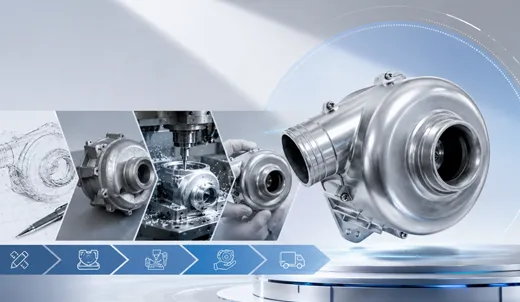
3.1 Prototype Management Protocol
When securing pre-production samples, procurement managers should follow a strict testing protocol:
- Submit complete technical engineering data sheets containing all operational constraints directly to the industrial cooling fan manufacturer.
- Acquire 1 to 3 prototype units. Ensure that internal motor windings, impeller geometry, and material finishes exactly match the final mass production specifications.
- Execute an official Prototype Parameter Freeze Agreement. Any engineering updates required past this point must follow a formal Engineering Change Notice (ECN) process.
3.2 Comprehensive Prototype Testing & Validation Criteria
Evaluate pre-production samples across four critical areas before approving mass production:
- Aerodynamic Curves: Map real-world airflow and static pressure using automated test ducts compliant with GB/T 1236-2017. Measured variance against the master design curve must remain tightly within ±2%.
- Real-World Efficiency: Measure static efficiency at nominal duty points to verify compliance with local environmental and energy mandates.
- Acoustic & Structural Vibration Testing: Deploy calibrated decibel microphones and multi-axis accelerometers. Confirm performance metrics meet targets (≤ 85 dB(A) and vibration levels ≤ 4.5 mm/s).
- Thermal Saturation (Temperature Rise Test): Run the blower sample under full load for 4 hours. Ensure that temperature rises on bearings and motor housings do not exceed 40°C above ambient room temperatures.
Technical QA & Troubleshooting Insights
Q1: How do changes in gas density affect industrial blower performance calculations?
A1: Industrial blowers are volumetric displacement systems; they displace identical physical fluid volumes ($m^3/h$) regardless of gas density. However, structural static pressure and overall motor power scale linearly with changes in gas density. Operating a blower in high-altitude environments or at elevated temperatures drops the gas density, which lowers the required shaft power but reduces the developed pressure downstream. Always convert site conditions to Standard Air Conditions (20°C, 101.325 kPa, 1.2 kg/m³) during the calculation stage.
Q2: What causes industrial blower vibration to exceed the standard 4.5 mm/s safety threshold?
A2: Excessive vibration usually stems from three main mechanical issues: dynamic impeller unbalance caused by particulate buildup or uneven surface erosion; structural motor shaft misalignment; or localized bearing degradation from inadequate lubrication. If high vibration occurs during prototype evaluation, run a dynamic balance test and verify that the base anchor points are isolated from surrounding structural harmonics.
Q3: Why should an engineer specify IE4/IE5 motors over cheaper IE3 alternatives for bulk procurement?
A3: While IE4/IE5 premium motors carry a higher initial purchase price, electricity consumption accounts for roughly 85% to 90% of an industrial blower's total life-cycle cost. Upgrading to IE4/IE5 standards cuts energy losses by 3% to 5%. In continuous 24/7 manufacturing plants, this efficiency gain typically covers the initial equipment price difference within 12 to 18 months of commissioning.
Q4: What is the mechanical difference between Roots blowers and Centrifugal blowers in wastewater aeration?
A4: Roots blowers use a positive displacement design that delivers a constant volume of air even as water levels and backpressure fluctuate in aeration tanks. Centrifugal designs rely on fluid velocity to generate pressure; if system resistance rises unexpectedly, their airflow delivery drop-off can be significant. For deep tanks with varying fluid levels, Roots models offer greater process stability, while Centrifugal systems provide higher peak efficiency under steady, low-resistance conditions.