

24V vs. 48V Blowers: Comprehensive Comparison of Performance, Power, and Design
In modern thermal management, industrial ventilation, and forced-air system engineering, choosing the right low-voltage air-moving solution is pivotal. Among the array of configurations available, 24V DC blowers and 48V DC blowers stand out as the two most heavily utilized systems across multiple demanding fields. These heavy-duty thermal management components are widely integrated into industrial automation, telecommunication enclosures, enterprise data centers, medical ventilators, and emerging renewable energy storage facilities.
Selecting whether a 24V or 48V architecture powers your thermal assembly yields a direct and profound impact on total system operating efficiency, continuous power draw, wire routing complexity, and long-term operating durability. This detailed technical whitepaper evaluates 24V versus 48V high-performance blowers across three crucial engineering pillars—Core Aerodynamic Performance, Electrical Power Configuration, and Electromechanical Structural Design—to deliver a definitive selection guide for procurement specialists and system engineers worldwide.
Industry Focus: With electronics densities increasing exponentially, thermal engineers no longer just look at cubic feet per minute (CFM) values. They look at total electrical infrastructure overhead, where nominal voltage configurations play a definitive role in minimizing line drop and maximizing power density.
1. Core Aerodynamic Performance: Rotational Speed, Airflow, and Static Pressure
Aerodynamic capability serves as the baseline requirement when assessing a cooling blower or centrifugal fan assembly. Key operational metrics include operational speed (RPM), total airflow capacity, maximum static pressure threshold, and emissions noise levels. Voltage input behaves as a key regulatory agent impacting these final thresholds.
1.1 Rotational Speed (RPM) Dynamics
Given an identical frame size, housing geometry, and internal impeller design, a premium 48V DC blower inherently registers a higher rated operational speed compared to its 24V DC blower counterpart, typically realizing a speed advantage ranging between 30% to 50%. Take the standardized premium C6001 industrial blower fan platform as an empirical reference: while both alternative voltage motor windings can theoretically target high peak velocities up to 47,000 RPM under zero-load setups, the 48V variant demonstrates substantially greater structural velocity stability and increased kinetic torque delivery under heavy aerodynamic loads.
The electrical physics behind this phenomenon are direct: the mechanical output velocity of a direct current brushless motor correlates linearly with standard electromotive input voltage. Increased voltage parameters enable the motor to consistently exert greater torque, making 48V industrial blowers highly resilient against rapid RPM deceleration when faced with intense aerodynamic backpressure.
1.2 Airflow Capacity (CFM / Volumetric Delivery)
Total airflow volumetric metrics determine how effectively heat can be extracted or fresh ambient air can be distributed throughout an active enclosure. In this regard, the 48V voltage class commands an expansive volumetric advantage. For instance, considering the highly standardized 12032 industrial blower platform (measuring 120x120x32 mm), a high-tier 24V implementation delivers a continuous airflow range of approximately 0.75 to 1.0 m³/min.
Conversely, a matching 48V configuration engineered into the exact same spatial footprint elevates delivery metrics to a range of 0.9 to 1.19 m³/min—generating a net volumetric performance boost of roughly 20%. For space-constrained industrial facilities, server arrays, and plant air management, leveraging 48V blowers scales up absolute CFM cooling thresholds without requiring bulky modifications to the physical enclosure.
1.3 Static Pressure Performance Curves
Static pressure (quantified via Pascals or Kilopascals) evaluates an air mover's ability to drive air currents through substantial mechanical resistance, such as narrow duct networks, dense air filtration panels, or compact heat sinks. 48V DC blowers display absolute superiority under high-impedance conditions, demonstrating maximum static pressure ceilings that measure 1.2 to 2 times greater than matching 24V units.
For example, a high-speed C6001-24V-L configuration offers a peak static pressure threshold of 8.0 kPa. The corresponding 48V industrial blower model not only achieves this benchmark with ease but sustains operational reliability well into highly elevated pressure regions. Consequently, the 48V specification represents the premium choice for medical-grade continuous positive airway pressure (CPAP) devices, advanced respirators, high-efficiency particulate air (HEPA) filtration arrays, and long-reach industrial ducting environments where constant pressures between 6 to 18 kPa are routinely encountered.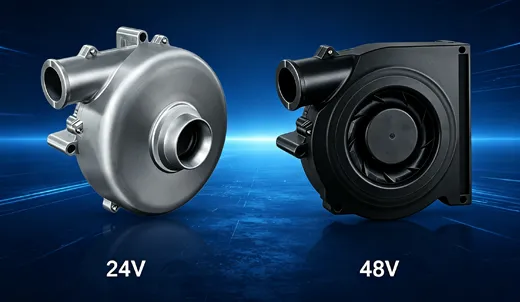
1.4 Operational Acoustic Noise Output
Acoustic emissions represent a critical design consideration concerning operator safety and regulatory compliance. When mapped across equivalent electrical wattages, the 24V DC blower architecture regularly records lower acoustic noise profiles, functioning around 3 to 8 dB lower than standard 48V configurations. Because 48V blowers operate at higher average RPM levels and generate substantial torque, they introduce additional aerodynamic shearing noise and minor mechanical vibration. For clinical environments, laboratory instruments, and noise-restricted office environments, the 24V blower model is historically favored.
| Performance Metric | 24V DC Blower Specification | 48V DC Blower Specification | Engineering Variance & Explanation |
|---|---|---|---|
| Rated Rotational Speed | 3,000 ~ 40,000 RPM | 4,500 ~ 47,000 RPM | 48V models yield a 30% to 50% increase in stable mechanical velocity. |
| Maximum Volumetric Airflow | 0.75 ~ 1.0 m³/min | 0.9 ~ 1.19 m³/min | 48V models secure an approximate 20% surge in raw volumetric output. |
| Peak Static Pressure Ceiling | 4.0 ~ 8.0 kPa | 8.0 ~ 12.0 kPa | 48V variants increase structural static pressure limits by 50% to 100%. |
| Acoustic Noise Footprint | 45 ~ 55 dB | 50 ~ 60 dB | 48V models exhibit an acoustic increase of 3 to 8 dB due to high velocity. |
2. Power Configuration Analysis: Rated Power, Current Draw, and Efficiency Metrics
Electrical attributes determine power management infrastructure requirements, conductor gauge choices, and safety profiles. Evaluating electrical parameters requires looking closely at rated wattage thresholds, running current levels, and cumulative energy efficiency.
2.1 Rated Power Thresholds
While the operational power limits of 24V and 48V architectures share minor overlap, their targeted application spheres differ markedly:
- 24V Power Class: Dominates primarily within the 10W to 150W low-to-medium power segment. Common market variations feature standard configurations like 76.8W and 80W power limits.
- 48V Power Class: Positioned squarely within the 50W to 500W medium-to-high capacity segment. High-demand industrial platforms utilize heavy-duty 48V motor assemblies reaching 200W or greater to drive heavy impellers.
When evaluated at an identical electrical workload—such as a continuous 100W payload—a 48V brushless DC blower operates under far lower thermal stress and lower running current, adding structural longevity to the host system.
2.2 Continuous Running Current (Amperage)
Derived via Ohm's Law and basic power equations ($P = V \times I$), operating current is inversely proportional to system input voltage under equivalent power parameters. Reviewing a standard 100W blower system demonstrates the following metrics:
For a 24V blower configuration, the running current calculates to approximately 4.17 Amps. For a matching 48V blower configuration, the required current drops to roughly 2.08 Amps. Halving the operating amperage provides three immense engineering benefits:
- Reduced Conductor Gauge Overhead: Lower running amperage enables system assemblers to deploy slimmer wire gauges. While a 24V setup requires robust 14 AWG wiring bundles, a 48V deployment runs comfortably on light 18 AWG wiring, drastically scaling down raw material acquisition costs and enclosure weight.
- Minimized Power Line Losses: Conductor line drop and thermal dissipation scale relative to the square of current ($P_{loss} = I^2R$). Transitioning to a 48V power distribution grid achieves a massive 75% reduction in interconnect power losses, optimizing total energy yields.
Enhanced Core Operational Safety: Lower running currents reduce wire overheating risks, safeguarding circuitry against short circuits or thermal runaway. This is especially vital for large industrial layouts and outdoor installations with long cable runs.
2.3 Energy Efficiency and Thermal Conversion Profiles
High-voltage 48V DC brushless blowers deliver superior energy efficiency, particularly when running under full operational workloads. This performance edge is driven by specific electrical advantages: reduced operating current decreases copper losses ($I^2R$ losses) within the motor windings; higher voltage inputs allow the brushless motor to operate consistently within its optimal speed-to-torque curve; and diminished line losses preserve incoming power. Verified bench testing indicates that under identical volumetric airflow and static pressure outputs, a 48V blower consumes 15% to 25% less raw electrical energy than a comparative 24V setup, translating into substantial long-term cost savings for data centers and large-scale manufacturing plants.
| Electrical Measurement (At 100W Payload) | 24V DC Blower Configuration | 48V DC Blower Configuration | Engineering Advantage Allocation |
|---|---|---|---|
| Rated Consumption Wattage | 100 Watts | 100 Watts | Parity across electrical conversion limits. |
| Running Amperage Load | ~ 4.17 Amps | ~ 2.08 Amps | 48V Advantage: Reduces current burden by 50%. |
| Recommended Wire Gauge Standards | 14 AWG Conductor Core | 18 AWG Conductor Core | 48V Advantage: Thinner wiring saves cost and space. |
| Conductor Loss Metrics (10-Meter Run) | ~ 4.17 Watts Loss | ~ 1.04 Watts Loss | 48V Advantage: Eliminates 75% of line drop wastage. |
| Total System Power Efficiency | 75% ~ 80% | 85% ~ 90% | 48V Advantage: Gains up to 10% pure efficiency. |
3. Electromechanical Structural Design: Motor Engineering, Wiring, and Thermal Management
Operating voltages dictate deep structural changes within internal brushless DC motors, safety insulation schemes, environmental ingress ratings, and native cooling layouts.
3.1 Internal Motor Architecture
The motor windings inside a 24V DC blower feature a higher number of coil turns paired with thinner magnet wire diameters, meaning it has relatively lower insulation barrier demands. This compact construction is cost-effective to manufacture, making 24V models ideal for budget-conscious projects.
Conversely, a 48V blower motor employs fewer coil turns composed of thicker magnet wires, combined with premium Class B or Class F insulation standards. These robust electrical properties generate exceptional torque density and enhanced thermal endurance, allowing 48V models to maintain a long operational lifespan of up to 70,000 hours at ambient temperatures of 40°C. However, their advanced design and tighter engineering tolerances increase initial manufacturing costs by 10% to 20% over 24V models.
3.2 Power Distribution and Controller Infrastructure
The 24V power architecture is an established legacy standard in industrial automation, integrating seamlessly with PLC controllers, automation relays, and standard field sensors. Matching replacement components are highly affordable and widely available worldwide. However, high-power setups require thick wiring bundles that can complicate routing within tight spaces.
In contrast, 48V power architecture serves as the primary standard across telecom networks, cellular basestations, and server infrastructures, backed by a vast ecosystem of high-capacity battery backups and modular power supplies. It supports long cable runs with clean, minimal wiring and aligns perfectly with modern solar PV grids, industrial energy storage systems (ESS), and electric vehicle architectures. The primary trade-off is the higher cost of specialized 48V power supplies and potential integration hurdles in older, legacy 24V industrial control environments.
3.3 Environmental Ingress Protection (IP Ratings)
Both 24V and 48V blower assemblies can be engineered to meet rugged IP68 dust- and water-protection standards, allowing them to perform reliably in harsh settings. However, their internal thermal dynamics suit different environmental profiles:
- 24V Industrial Blowers: Deliver reliable performance in extremely low temperatures. With standard operating ranges spanning from -40°C to +50°C, they excel in rugged outdoor equipment, cold-chain transport systems, and agricultural machinery.
- 48V Industrial Blowers: Offer exceptional high-temperature resilience, operating reliably in environments up to +60°C. This makes them ideal for enclosed, heat-intensive spaces like telecom server racks, industrial furnace controls, and power inverters.
3.4 Thermal Dissipation Architecture
Because 24V blowers generate lower total wattage and minimal localized heat, they cool efficiently through standard convective heat dissipation across their housing. This eliminates the need for bulky add-on cooling components, maintaining a lightweight and space-saving footprint.
On the other hand, high-wattage 48V blowers require dedicated thermal management, such as integrated aluminum cooling fins or optimized internal airflow channels. Premium models feature specialized dual-channel cooling paths to ensure stable, continuous operation during prolonged, full-load industrial tasks.
| Design Domain | 24V DC Blower Architecture | 48V DC Blower Architecture | Practical System Design Impact |
|---|---|---|---|
| Motor Coil Configuration | High turn counts, thin wire diameter. | Low turn counts, heavy wire gauge. | 48V designs provide enhanced torque and extended durability. |
| Insulation Class Standard | Class A / Class E Ratings | Class B / Class F Ratings | 48V blowers exhibit superior thermal resilience. |
| Interconnect Routing Costs | Higher (requires thick copper wires). | Lower (runs efficiently on thin wires). | 48V simplifies long-distance industrial wiring layout. |
| Thermal Component Profile | Basic natural convection cooling. | Integrated cooling fins / heat sinks. | 24V offers a compact footprint; 48V ensures full-load reliability. |
| Base Production Pricing | Baseline standard cost. | 10% to 20% production premium. | 24V suits cost-sensitive budgets; 48V delivers premium performance. |
4. Application Selection Matrix: Determining the Optimal Voltage Strategy
To choose the correct blower voltage, engineers must align the blower's electrical specifications and aerodynamic output with the system's power supply and active workload demands.
4.1 When to Prioritize 24V DC Blowers
- Standard Industrial Automation Systems: Ideal for PLC control panels, manufacturing relays, and sensor enclosures. These systems use standard 24V power distribution, allowing direct plug-and-play integration without extra voltage converters.
- Medical Equipment & Clinical Lab Devices: Critical for patient ventilators, blood analyzers, and incubation chambers. These applications rely on the 24V blower's low acoustic noise and stable, low-pressure airflow.
- Mobile & Portable Instruments: Perfect for battery-operated field gear, mobile diagnostic tools, and portable aesthetics equipment. These systems take advantage of highly affordable and readily available 24V battery packs.
- Cost-Driven Commercial Projects: The best choice for small-scale workshop ventilation, commercial appliances, and entry-level automation tools, keeping procurement and wiring costs well within strict budgets.
4.2 When to Prioritize 48V DC Blowers
- Enterprise Telecom Enclosures & Data Centers: Designed to fit standard 48V backup battery grids and server racks. High energy efficiency and minimal line loss significantly lower ongoing utility costs for large installations.
- High-Wattage Industrial Facilities: Crucial for industrial furnace ventilation, dust extraction hoods, and long-distance duct networks. The high static pressure and volumetric airflow easily overcome complex mechanical resistance.
- Renewable Energy Systems & EV Technology: Vital for cooling solar power inverters, utility-scale battery storage banks (ESS), and electric vehicle charging hubs, matching standard 48V renewable energy power profiles perfectly.
- Long-Distance Outdoor Equipment: Essential for remote telecom basestations, offshore monitoring gear, and heavy agricultural systems. Lower running currents eliminate voltage drops over long cable runs, while IP68 enclosures protect against harsh weather.
5. Decision Checklist for Technical Engineers
When finalizing your selection between a 24V or 48V blower, use this three-step verification process:
Step 1: Check Native Power Rails: Identify the primary power supply of your host system. If a reliable 24V or 48V power source is already available, matching the blower to that native voltage avoids the cost and space of extra power converters.
Step 2: Calculate Air Impedance (Static Pressure): Map out your system's complete airflow path. If the air must pass through high-resistance barriers like long ducts, complex bends, or thick HEPA filters, choose a 48V blower to ensure the necessary static pressure.
Step 3: Evaluate Environmental and Operational Constraints: Balance your project's acoustic, thermal, and budgetary needs. For noise-sensitive clinical settings or tight budgets, choose a 24V model. For harsh, high-temperature settings or long, outdoor cable runs, select a high-efficiency 48V blower.
Technical FAQ: 24V vs. 48V DC Brushless Blowers
Can I safely run a 24V DC blower using a 48V power supply network?
No, connecting a 24V DC blower directly to a 48V power supply will over-voltage the internal motor control circuitry, leading to immediate component failure, burned insulation windings, and permanent hardware damage. To connect them safely, you must install a step-down step-down DC-DC buck converter to lower the 48V supply voltage to a stable 24V output.
Why do 48V industrial blowers show higher energy efficiency than 24V alternatives?
According to Joule's Law, electrical power losses across conductors drop significantly when current decreases ($P = I^2R$). Because 48V systems operate at double the voltage of 24V systems, they require half the continuous amperage to deliver the same wattage. This lower current draw reduces copper losses in the motor windings and minimizes voltage drop along supply cables, improving total system efficiency by 15% to 25%.
Which voltage framework is best for medical ventilators and clinical respirators?
For low-pressure, patient-proximal medical devices, 24V DC blowers are preferred because they operate with lower acoustic noise and minimal mechanical vibration. However, for high-acuity medical ventilators, advanced intensive-care systems, or respirators with heavy built-in filtration, engineers select 48V blowers. The 48V motor delivers the high static pressure (6 to 18 kPa) needed to overcome filter resistance and maintain stable air delivery.
How do wiring costs change when migrating an industrial facility from 24V to 48V blowers?
Migrating to a 48V architecture significantly reduces total wiring costs, especially in large installations with long cable runs. Because 48V motors run at half the current of 24V models, you can switch from thick, expensive 14 AWG copper wiring to lighter, highly flexible 18 AWG wiring. This thin wiring saves valuable installation space, simplifies wire routing, and reduces bulk copper material costs.
GET A QUOTE