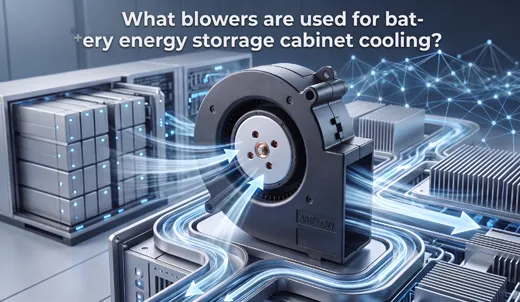


Key Differences and Applications of Blowers vs. DC Fans: Ultimate Industrial Selection Guide
An in-depth analysis of structural engineering, working principles, static pressure, and thermal performance to optimize your equipment's cooling efficiency.
In modern industrial thermal management, ventilation, and air-handling systems, DC fans and industrial blowers are the two most ubiquitous forced-air cooling components. While their fundamental objective remains identical—driving airflow to dissipate heat or transport gases—their mechanical architecture, thermodynamic behavior, volumetric capacity, and pressure-generation capabilities diverge significantly.
Thermal engineers, system designers, and procurement managers frequently conflate blowers with DC axial fans. This architectural misunderstanding often leads to improper hardware selection, catastrophic thermal throttling, excessive energy consumption, and premature failure of high-value mechanical equipment. To mitigate these operational risks and optimize system coefficient of performance (COP), this comprehensive technical guide analyzes the structural variations, core parameters, and real-world deployment scenarios for both technologies.
1. Engineering Definitions and Thermodynamic Working Principles
1.1 Understanding Axial DC Fans
A DC fan (specifically an axial cooling fan) is an air-moving device powered by direct current through either brushed or brushless DC (BLDC) motors. It forces air to move parallel to the shaft around which the blades rotate. In essence, the intake and exhaust streams flow along the exact same linear axis.
Modern industrial applications exclusively utilize brushless DC fans due to their lack of mechanical brushes, which minimizes friction, eliminates electrical arcing, increases operational lifespan, and allows for precise speed control via Pulse Width Modulation (PWM). The primary aerodynamic objective of an axial DC fan is to provide high-volume volumetric displacement under low resistance, moving massive amounts of air across broad open spaces.
1.2 Understanding Centrifugal Blowers
Conversely, an industrial blower typically utilizes a centrifugal or cross-flow architecture to deliver highly concentrated, high-pressure streams of air. Instead of moving air linearly, a centrifugal blower draws air axially into its center inlet and flings it outward at a 90-degree angle using a high-speed rotating impeller encased within a rigid scroll or "snail" housing.
As the impeller blades accelerate the incoming air kinetic energy is converted into dynamic pressure head inside the narrowing scroll housing. The air is compressed and forced out through a constricted discharge nozzle. This geometric construction allows blowers to generate immense static pressure, making them capable of pushing air through highly restrictive pathways, long ducts, dense filters, and sealed thermal chambers.
2. Direct Technical Confrontation: Blowers vs. DC Fans
To establish distinct application boundaries for system engineering, we must examine the specific fluid dynamics and mechanical metrics that differentiate these two cooling systems.
| Technical Metric | Axial DC Cooling Fans | Centrifugal Blowers |
|---|---|---|
| Airflow Direction | Linear (Parallel to axis) | Perpendicular (90-degree discharge) |
| Air Volume (CFM) | Extremely High (Broad coverage) | Moderate to Low |
| Static Pressure | Low (Fails against high resistance) | Extremely High (Overcomes high impedance) |
| Housing Geometry | Open Frame (Compact) | Enclosed Scroll / Volute Housing |
| Acoustic Profile | Lower Noise (Smooth blade slicing) | Higher Noise (Air compression effects) |
2.1 Structural Geometry & Space Constraints
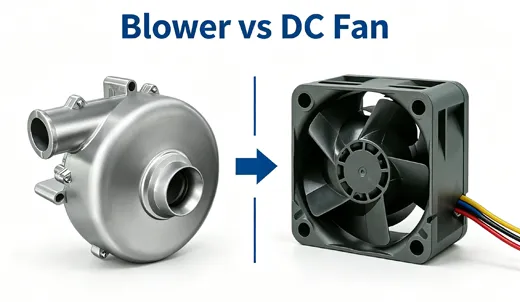
Axial DC fans feature an open-frame design with exposed blades. Because the intake and outtake are inline, the housing is thin, lightweight, and incredibly compact. This allows them to be mounted directly onto heatsinks, server chassis doors, or device enclosures with minimal modification.
Centrifugal blowers are intrinsically bulkier due to the aerodynamic necessity of the scroll volute housing. They require specialized mounting orientations because the exhaust path is directed to the side. However, their structurally enclosed design provides greater physical protection against mechanical impacts and harsh operational environments.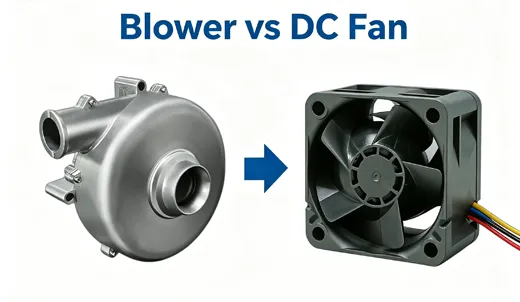
2.2 Fluid Dynamics: Airflow Volume vs. Static Pressure Resistance
The core selection criteria boils down to the system impedance curve. Every system presents resistance to airflow, known as system impedance, caused by PCBs, wires, air filters, dust, and changes in duct diameter.
Axial fans are ideal for low-impedance systems. They excel when you need to pull heat away from an open circuit board or exhaust warm ambient air out of an enclosure. However, if an axial fan faces a restrictive HEPA filter or a convoluted winding duct, its airflow rate plummets dramatically due to its low static pressure threshold, leading to air stall and thermal buildup.
Blowers are explicitly engineered to battle high-impedance systems. Even when faced with dense physical barriers, narrow channels, or long ventilation pipes, the blower compresses the air molecules within its housing, ensuring that a stable, concentrated, high-velocity stream of air is delivered exactly where it is needed.
3. Typical Application Use-Cases for DC Axial Fans
Thanks to their high volumetric efficiency, lower acoustic levels, and energy efficiency, DC axial fans are dominant in open-air cooling applications across commercial electronics and light industrial sectors:
- Enterprise Computing & Data Centers: Cooling high-density rack-mount servers, network switches, routers, and uninterruptible power supplies (UPS).
- Consumer Electronics & White Goods: Standard cooling inside desktop computers, 4K projectors, smart refrigerators, and home air purifiers.
- Renewable Energy Systems: Providing overall ambient ventilation for EV charging stations, solar inverters, and battery management enclosures.
- Industrial Automation Cabinets: Constant air exchange in electrical control panels and PLC cabinets to preserve component lifespan.
4. Typical Application Use-Cases for Industrial Blowers
Where high static pressure and target localized airflow are mandatory, standard axial fans fail, making centrifugal blowers completely irreplaceable:
- Medical Equipment: Providing a precise, highly reliable high-pressure air supply in CPAP machines, mechanical ventilators, and oxygen concentrators.
- Environmental Systems & Filtration: Pulling or pushing air through heavy carbon filters, industrial exhaust scrubbing systems, and long exhaust ducts.
- Pneumatic Conveying & Material Handling: Utilizing high-pressure air vectors to move pellets, dust, particulate matter, or granular components through factory pipelines.
Precision Spot Cooling: Concentrating a high-velocity jet stream onto targeted ultra-hot zones, such as laser cutting heads, 3D printer extruders, or high-power LEDs.
5. Professional Engineering Selection Matrix
When finalizing your thermal management schematic, use this rapid engineering checklist to determine whether you should source an axial fan or a centrifugal blower:
Deploy a DC Axial Fan if:
1. The target environment is largely unrestricted, open-air, or low resistance.
2. You require widespread, uniform volumetric displacement (high CFM).
3. Acoustic constraints dictate low dBA decibel operation.
4. Spatial depth is highly constrained, requiring a flat profile layout.
Deploy a Centrifugal Blower if:
1. The airflow path includes intricate bends, long pipes, micro-channels, or air filters.
2. The system exhibits high static pressure resistance.
3. You require localized, concentrated spot cooling or positive pressure sealing.
4. The equipment demands high mechanical robustness against physical resistance.
6. Conclusion
In summary, the choice between a DC fan and a blower is not a matter of which component is superior, but rather which system matches your thermal impedance environment. Selecting the correct architecture will significantly optimize heat dissipation, improve system performance, reduce operational power drain, and extend the mean time between failures (MTBF) of your industrial infrastructure.
Technical FAQ: Blowers vs. DC Fans
Q1: Can I replace a blower with a DC axial fan to reduce noise?
Generally, no—unless you significantly redesign your internal wind tunnel geometry. While axial DC fans operate with a quieter acoustic profile, they cannot generate the static pressure required to overcome high system impedance. Swapping a blower for an axial fan in a restricted system will likely cause air stall, leading to rapid device overheating.
Q2: Why do centrifugal blowers draw more power than axial fans?
Centrifugal blowers do more thermodynamic work on the air. They physically compress the air molecules inside the enclosed scroll casing to generate high static pressure. This additional mechanical and thermodynamic load requires higher torque from the motor, which consequently demands more electrical power compared to an unrestricted axial fan moving the same mass of air.
Q3: How does Pulse Width Modulation (PWM) benefit both fan types?
PWM allows intelligent control systems to modulate the duty cycle of the BLDC motor, dynamically scaling rotation speeds based on real-time temperature feedback sensors. This saves immense amounts of energy when the system is idling and significantly extends the operational lifespan of the bearings in both fans and blowers.
Q4: What happens if a DC axial fan is forced to operate in a high-resistance environment?
When forced against resistance higher than its maximum rated static pressure, an axial fan enters an aerodynamic "stall" state. The air begins to recirculate around the blade tips instead of passing through, causing the airflow to drop to near-zero, increasing vibration, and rapidly elevating the temperature of your industrial equipment.