

How to Evaluate DC Blower Performance: CFM Airflow, kPa Static Pressure, Noise Levels, and Lifespan
Selecting the perfect DC blower fan for industrial enclosures, electronics cooling, ventilation systems, or air circulation environments requires a rigorous, data-driven approach to performance evaluation. All too often, procurement managers and hardware engineers focus strictly on physical dimensions or voltage requirements. Overlooking the foundational aerodynamic and mechanical metrics invariably leads to catastrophic system failures—such as insufficient heat dissipation, excessive acoustics, abbreviated operating lifespans, and high field-failure rates.
To secure a highly stable, cost-effective, and heavy-duty cooling solution, engineering professionals must judge a high-pressure blower by four core technical benchmarks: CFM airflow, kPa static pressure, noise levels (dB), and operational lifespan. This comprehensive technical guide breaks down the underlying physics, system integration logic, application environments, and selection methodologies to help you optimize your thermal management blueprints.
1. Evaluating Thermal Efficiency via CFM (Cubic Feet per Minute) Airflow
CFM airflow (Cubic Feet per Minute) measures the volumetric rate of air a DC blower fan can displace. It serves as the baseline indicator of a fan’s structural ventilation capacity and raw thermal dissipation speed. Fundamentally, a higher CFM rating indicates that a larger volume of air is moved per unit of time, which allows the system to sweep away heat accumulated within a chassis more quickly.
In thermal engineering calculations, CFM dictates the baseline heat extraction capacity under zero-resistance conditions. In wide-open systems, high volumetric flow is the primary mechanism for rapid temperature drops. However, evaluating CFM in a vacuum is a critical engineering mistake. A blower boasting exceptional open-air CFM but low static pressure will stall when integrated into real-world applications featuring air filters, complex ductwork, or dense PCB layouts, resulting in zero actual cooling.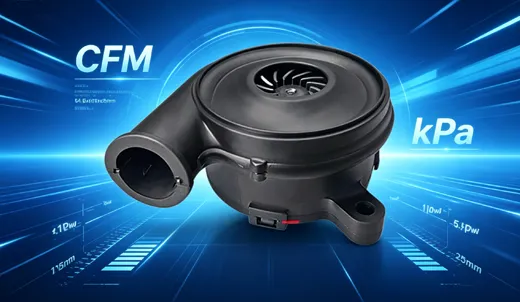
Proper selection requires mapping system power dissipation (Watts) directly to the target CFM. For instance, compact or miniature blowers (such as 5025 or 9733 frame sizes) generally yield 20 to 50 CFM. These are ideal for medical devices, projectors, and compact power supply units (PSUs). Conversely, heavy-duty industrial blowers can generate 80 to over 150 CFM, catering to dense server racks and large industrial control cabinets. A premium blower will sustain its rated CFM output across extended duty cycles without thermal degradation of the motor.
2. Overcoming System Impedance with kPa Static Pressure
Static pressure (measured in Pascals, kPa, or mmH₂O) represents a blower’s capacity to overcome aerodynamic resistance. It is the defining operational distinction between an axial fan and a high-pressure blower. While CFM determines total volume, kPa static pressure determines whether that air can actually pierce through dense internal arrays, air filters, tight bends, or heat sinks to reach the thermal core.
Most modern electronics and enclosed industrial cabinets feature high-density internal layouts to minimize physical footprints. Standard axial fans lose performance immediately when facing such systemic backpressure, as air slips backward across the blades. Centrifugal blowers overcome this through a localized vortex design, trapping air inside the housing and pushing it forward with significant force.
| Blower Classification | Typical Static Pressure | Primary Application Environments |
|---|---|---|
| Miniature / Precision Blowers | 0.2 – 0.6 kPa (20 – 60 mmH₂O) | CPAP medical devices, projectors, telecom modules |
| Standard Industrial Blowers | 0.6 – 3.0 kPa (60 – 300 mmH₂O) | Charging stations, air filtration, industrial servers |
| Heavy-Duty High-Pressure Blowers | 3.0 – 10.0+ kPa (300 – 1000+ mmH₂O) | Pneumatic conveying, harsh industrial ventilation, deep ducting |
When converting performance metrics across data sheets, remember the engineering benchmark: 1 mmH₂O is roughly equal to 0.0098 kPa. Premium blowers are designed with an optimized P-Q (Pressure vs. Flow) curve. This balances high volume delivery alongside robust static pressure capabilities, ensuring your system does not stall out midway through operation under high-impedance conditions.
3. Noise Levels (dB): Measuring Acoustic Comfort and Structural Build Precision
Acoustic performance, measured in decibels (dB), is a vital indicator of structural engineering quality. Excessive noise levels do more than disrupt operators or violate office environmental rules; they often point to structural issues like poor dynamic blade balance, inefficient motor configurations, or housing resonances.
High-end blowers leverage computational fluid dynamics (CFD) to design scroll housings and impeller blades that limit air turbulence and mechanical friction. When comparing blowers with identical CFM and static pressure metrics, the unit with the lower dB rating reflects superior manufacturing tolerances and design precision. For consumer, office, or medical equipment, blowers are generally calibrated to run between 30 and 55 dB to ensure quiet operation.
Engineering Best Practice: Always evaluate both free-air (unloaded) noise and loaded noise. Budget blower options may seem quiet in free-air tests but can whine or vibrate heavily once subjected to backpressure. Certified blowers maintain stable acoustics across their entire load profile without producing irregular mechanical harmonics.
4. Operational Lifespan: Ensuring Long-Term System Reliability
For critical systems that run continuously, the operational lifespan of a cooling blower is just as important as its immediate performance metrics. A sudden fan failure can quickly overheat adjacent electronics, triggering system downtime and expensive maintenance calls. A blower's long-term durability relies heavily on its motor configuration and bearing architecture.
Modern industrial blowers use efficient brushless DC (BLDC) motors instead of older brushed versions, which wear out rapidly due to brush friction. Premium BLDC blowers use dual-ball bearing or advanced fluid dynamic bearing (FDB) designs to achieve rated lifespans of 30,000 to over 50,000 hours of continuous 24/7 use.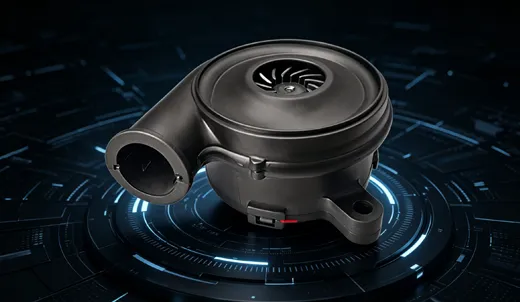
Investing in a component with an extended lifespan pays off by lowering your total cost of ownership (TCO). Low-quality components often suffer from grease migration or bearing wear, which leads to speed drops, reduced airflow, and eventual seizure within months of deployment.
5. Holistic Balancing Matrix for Custom Integration
Optimizing a thermal design means finding the right balance across all four parameters rather than maximizing just one. The best combination depends entirely on your specific application needs:
- Open-Air / Unobstructed Exhaust: Prioritize maximum CFM and low operational noise (dB). Static pressure can remain a secondary focus.
- High-Impedance Enclosures (Filters, Heat Sinks, Ducts): Prioritize high kPa static pressure to maintain reliable airflow across the load profile.
- Continuous Remote Installations (Telecom Towers, Industrial Nodes): Prioritize an extended operational lifespan and low speed-attenuation metrics to minimize field service visits.
Industry-standard high-performance blowers—such as the BA5025H24B-A-I or 9BMB12P2S01—demonstrate this balance perfectly. They combine high volumetric flow rates with robust pressure delivery, controlled acoustics, and highly durable internal electronics to deliver dependable cooling in demanding environments.
Technical Knowledge Base & FAQ
Q1: What is the main difference between an axial cooling fan and a centrifugal blower fan?
Axial fans draw air parallel to the shaft and discharge it in the same direction, making them well-suited for high-volume, low-resistance air moving applications. Centrifugal blowers draw air in axially but deflect it outward perpendicularly at a 90-degree angle. This centrifugal action allows blowers to build substantially higher static pressure (kPa), making them much better at forcing air through restrictive, obstructed, or tightly packed enclosures.
Q2: How do you convert static pressure from mmH₂O to kPa accurately?
To convert standard millimeter water column units (mmH₂O) to kilopascals (kPa), multiply the pressure value by 0.009806. For example, if a heavy-duty industrial cooling blower generates a static pressure of 250 mmH₂O, the conversion calculation is: 250 × 0.009806 = 2.45 kPa.
Q3: Why does a cooling blower's noise level increase sharply when installed inside a chassis?
This rise in acoustics is typically caused by two factors: system aerodynamic impedance and mechanical resonance. When a blower operates against high flow resistance, air turbulence increases within the scroll housing, raising the acoustic output. Additionally, if the blower is mounted directly to thin metal paneling without isolation dampeners, motor vibrations can transfer to the frame, turning the chassis into an acoustic amplifier.
Q4: Which bearing technology provides the longest operational lifespan for industrial DC blowers?
Precision dual-ball bearings and premium Fluid Dynamic Bearings (FDB) offer the longest operating life. Dual-ball bearings handle high operating temperatures and multi-axis mounting orientations extremely well, consistently achieving lifespans beyond 50,000 hours. Sleeve bearings are less expensive but prone to oil leakage and rapid friction wear, making them less suitable for reliable industrial electronics.