

Low Operating Voltage Blowers: Core Components for Thermal Management and Experiential Innovation in AR Glasses
Amidst the rapid wave of iteration in AR (Augmented Reality) glasses, thinness, high performance, long battery life, and low noise levels have emerged as core competitive differentiators. As a critical component for precision thermal management and airflow regulation, the low-operating-voltage blower directly determines the operational stability, wearing comfort, and service life of AR glasses. Unlike traditional, large-scale blowers, those designed for AR glasses must strike an exquisite balance across five key dimensions: low-voltage drive, miniaturization, ultra-low power consumption, silent operation, and high air-pressure efficiency. These blowers provide highly efficient thermal solutions for core heat-generating units—such as chips and optical modules—within AR glasses, while simultaneously meeting the stringent power supply and spatial constraints inherent to portable devices. This article offers an in-depth analysis of the application and value of low-operating-voltage blowers in the AR glasses sector, examining five key dimensions: technical characteristics, core advantages, application value, selection criteria, and industry trends. It aims to serve as a valuable reference for industry R&D, component selection, and product upgrades.
I. Core Definition and Technical Characteristics of Low-Operating-Voltage Blowers
(I)Low-operating-voltage blowers designed for AR glasses must feature parameters strictly tailored to the specific device application environment. The mainstream specifications are presented in the table below, focusing primarily on five key metrics: dimensions, voltage, power consumption, noise level, and air pressure.
| Parameter Category | Mainstream Specifications | Core Requirements / Features |
|---|---|---|
| Rated Voltage | DC 3V/5V (Range: 2-6V) | Compatible with AR glasses Li-ion batteries; low startup voltage (≤2V). |
| Dimensions | 15×15×3mm, 18×18×4mm, 20×20×4.5mm | Ultra-thin and miniaturized; fits into temples, frames, or optical modules. |
| Power Consumption | 0.25-1W (0.05-0.2A) | Ultra-low power design to minimize battery drain (<10% impact). |
| Speed Range | 6,000-14,000 RPM | High-speed rotation ensures efficient airflow in compact form factors. |
| Airflow / Pressure | 0.2-0.8 CFM / 15-50 Pa | High static pressure to overcome resistance in sealed AR cavities. |
| Noise Level | 25-32 dBA (@5cm distance) | Silent operation to maintain an immersive user experience. |
| Bearing Type | Hydraulic / Micro Ball Bearing | Long lifespan (≥40,000 hrs); low friction and maintenance-free. |
| Control Functions | PWM Speed Control / FG Signal | Supports intelligent speed adjustment based on real-time thermal load. |
(II) Core Structure and Material Design
The structural design of the low-operating-voltage blower centers on the core principles of "miniaturization, integration, lightweight construction, and high reliability." The materials and manufacturing processes for its critical components are specifically tailored to withstand the demanding operating environment of AR glasses:
1. Frame and Impeller: Constructed from PBT reinforced with 30% glass fiber and a V0-grade flame-retardant additive, the assembly is created via a single-step injection molding process. This design combines lightweight properties (unit weight < 15g) with high thermal resistance (-20°C to +85°C), as well as flame-retardant and anti-static characteristics, thereby preventing thermal deformation or electrostatic discharge damage to the AR glasses' precision electronic components. The impeller features a 21-blade design with an extended pitch angle, optimizing aerodynamic efficiency to generate high air pressure even at low rotational speeds, while simultaneously minimizing noise and power consumption.
2. Brushless DC (BLDC) Motor: Incorporating a miniature built-in BLDC motor, the unit utilizes Class B enamel-coated wiring capable of withstanding temperatures up to 120°C. It offers key advantages such as low start-up voltage, high energy efficiency, and minimal electromagnetic interference (EMI). This makes it ideally suited for the low-voltage power supply and sensitive circuitry environment typical of AR glasses, preventing motor-induced interference from compromising optical display quality or signal transmission integrity.
3. Bearing System: The system primarily employs long-life, oil-retaining hydraulic bearings or miniature dual ball bearings. These components ensure frictionless 360-degree rotation and silent operation, boasting a service life exceeding 70,000 hours. This guarantees stable, maintenance-free operation throughout the entire lifecycle of the AR glasses.
II. Core Advantages of Low Operating Voltage Blowers for AR Glasses
As "wearable smart terminals," AR glasses impose thermal management requirements that far exceed those of traditional electronic devices. With five core advantages—low-voltage compatibility, miniaturized integration, efficient heat dissipation, silent operation with low power consumption, and high reliability—low-operating-voltage blowers have emerged as the optimal thermal solution for AR glasses, effectively resolving the pain points associated with traditional cooling methods (such as passive cooling and axial fans).
(I) Low-Voltage Drive: Perfectly Compatible with AR Glasses' Power Supply System
AR glasses are typically powered by 3.7–5V lithium-ion batteries. Given the limited battery capacity (200–500mAh) and stringent requirements for battery life (requiring ≥4 hours of continuous use in a single scenario), low-operating-voltage blowers offer a distinct advantage. These blowers feature a rated voltage of 3V/5V and a wide operating voltage range (2–6V); they can start up stably at an ultra-low voltage of just 2V, eliminating the need for additional voltage-boosting circuitry. By connecting directly to the lithium-ion battery supply, they simplify circuit design and minimize power loss. In contrast to 12V blowers—which require a voltage-boosting module that incurs a 15–20% power loss—low-operating-voltage blowers consume only 0.25–1W of power, resulting in a battery life reduction of less than 10%. This significantly extends the operational duration of AR glasses, effectively resolving the inherent conflict between "high performance" and "high power consumption."
(II) Miniaturized and Ultra-Thin: Tailored for the Ultra-Slim and Lightweight Design of AR Glasses
The core user experience of AR glasses centers on "imperceptible wearability." Consequently, the device's overall thickness must be kept under 20mm, its weight under 50g, and the internal space within the temples and frames is extremely compact. Low-operating-voltage blowers are available in ultra-compact dimensions—as small as 18×18×4mm or 15×15×3mm—with a thickness of just 4–4.5mm and a weight of less than 10g. These units can be seamlessly embedded into the inner side of the temples, the top of the frames, or the narrow gaps between the optical modules and the mainboard. By occupying no additional space and adding no significant weight to the device, they perfectly align with the industry trend toward ultra-slim and lightweight AR glasses designs. Compared to traditional axial fans (with a thickness of ≥6 mm and a weight of ≥15 g), miniature blowers offer an improvement of over 50% in space utilization efficiency, thereby providing greater design freedom for the structural layout of AR glasses.
(III) High Air Pressure and Efficient Heat Dissipation: Addressing the Core Thermal Challenges of AR Glasses
The main control chip, optical projection module, and battery constitute the primary heat-generating components within AR glasses. During high-load operations—such as 4K display rendering or real-time spatial computing—chip temperatures can soar to between 60°C and 80°C. If this heat is not dissipated promptly, it can lead to display lag, image blurring, CPU throttling, battery swelling, or even trigger an automatic shutdown via overheating protection, thereby severely compromising both the user experience and the device's lifespan.
These low-voltage blowers feature a centrifugal airflow design capable of generating air pressures ranging from 15 Pa to 50 Pa—far exceeding that of similarly sized axial fans (which typically generate less than 10 Pa). This capability allows the blower to overcome the high airflow resistance inherent in the sealed internal cavities of AR glasses, generating a directional airflow that precisely targets and cools the surfaces of heat-generating components, thereby rapidly expelling heat into the external environment. Furthermore, integrated with intelligent PWM speed control, the blower automatically adjusts its rotational speed based on the chip's temperature: under low-load conditions (temperatures below 40°C), it operates at a low speed (6,000 RPM) with a power consumption of less than 0.3 W; conversely, under high-load conditions (temperatures above 60°C), it shifts to a high-speed mode (12,000 RPM) to maximize air pressure, boosting heat dissipation efficiency by over 30% and ensuring that the AR glasses maintain stable operation—with temperatures kept below 45°C—even during peak performance demands.
(IV) Silent Operation: Preserving the Immersive Audiovisual Experience of AR Glasses
The core value proposition of AR glasses lies in delivering an "immersive experience that seamlessly blends the virtual and real worlds." Users are highly sensitive to noise; any extraneous sound can disrupt this sense of immersion and detract from the overall user experience. To address this, the low-voltage blower employs a "triple-layer" noise-reduction design—combining aerodynamically optimized fan blades, high-precision bearings, and a vibration-damping structure. This design ensures ultra-quiet operation, with noise levels kept as low as 25–32 dBA (measured at a distance of 5 cm)—approaching the level of ambient silence—making the blower's operation virtually imperceptible to the wearer. Compared to traditional micro-fans (which generate noise levels of ≥40 dBA), this solution delivers a noise reduction improvement of over 40%. It effectively resolves the inherent conflict between "cooling efficiency and noise generation," thereby safeguarding the immersive audiovisual experience provided by AR glasses.
(V) High Reliability and Extended Lifespan: Designed to Span the Entire Lifecycle of Wearable Devices
As high-usage wearable devices, AR glasses demand exceptional stability, longevity, and maintenance-free operation to withstand the complex environmental conditions—such as vibration, temperature fluctuations, and dust—encountered during daily wear. This low-voltage blower utilizes an industrial-grade brushless motor, sealed bearings, and flame-retardant, anti-static materials. Endowed with robust resistance to vibration, high temperatures, dust, and static electricity, it operates stably within a temperature range of -20°C to +85°C. With a service life ranging from 40,000 to 70,000 hours—equivalent to 5 to 8 years of continuous operation—it is fully capable of spanning the entire product lifecycle of AR glasses. Furthermore, the blower incorporates safeguards against reverse voltage, overcurrent, and rotor lock-up; these protections prevent motor damage under abnormal operating conditions, thereby enhancing the device's overall reliability and reducing post-sales maintenance costs.
III. Core Application Scenarios for Low-Voltage Blowers in AR Glasses
The application of low-voltage blowers in AR glasses revolves around three core requirements: "precise heat dissipation, airflow regulation, and anti-fog/dehumidification." These applications span three major categories—consumer-grade, industrial-grade, and medical AR glasses—establishing the blower as a critical component for enhancing both product performance and user experience.
(I) Consumer-Grade AR Glasses: Daily Entertainment and Light Office Scenarios
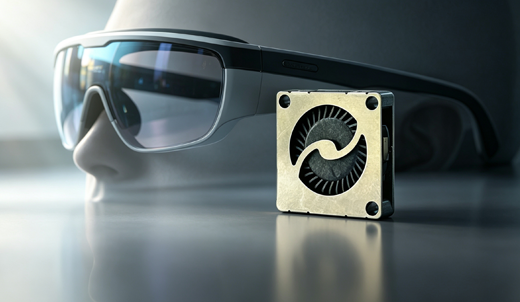
Consumer-grade AR glasses (e.g., Meta Ray-Ban, OPPO Air Glass) prioritize a lightweight, portable, and slim profile suitable for daily wear, entertainment, and office tasks. The primary heat-generating components are the main control chip (e.g., Snapdragon W5+) and the optical display module (e.g., MicroLED), with a heat output ranging from 1 to 3 watts. Consequently, these devices require a thermal management solution that is low-power, silent, and miniaturized. Low-voltage blowers are embedded within the inner side of the glasses' temples to provide targeted cooling for the main control chip and optical module. This ensures that the internal temperature remains below 45°C and noise levels stay under 30 dBA, thereby guaranteeing a "seamless" wearing experience—where the user remains unaware of the device's presence—during daily activities such as watching short videos, using navigation, or performing light office work, while maintaining a battery life of 4 to 6 hours. Furthermore, these blowers enable anti-fog and dehumidification functions: by circulating a subtle airflow, they equalize the temperature difference between the inner and outer surfaces of the lenses, preventing fogging when transitioning between environments with varying temperatures and thereby enhancing the user experience in outdoor or thermally fluctuating settings.
(II) Industrial-Grade AR Glasses: High-Temperature and High-Load Operation Scenarios
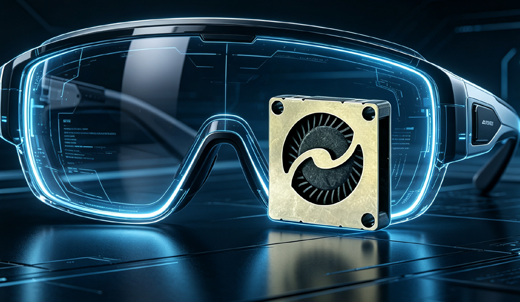
Industrial-grade AR glasses (e.g., RealWear, HMT-1) are designed for applications such as industrial inspection, maintenance guidance, and remote collaboration. These devices must operate under high-load conditions—involving real-time image transmission, spatial computing, and AI recognition—within harsh environments characterized by high temperatures (-10°C to +60°C), intense vibration, and high dust levels. With core heat-generating components producing between 3 and 5 watts of heat, these devices place rigorous demands on thermal dissipation performance. Low-voltage blowers designed for this sector feature high air pressure capabilities (40–50 Pa), a wide operating voltage range (2–6 V), and a reinforced bearing design. This robust construction enables stable operation even in high-temperature environments, allowing for the rapid extraction of heat generated during high-load tasks. By preventing CPU throttling or system crashes, these blowers ensure the uninterrupted continuity of industrial operations. Additionally, the blower features IP54 dust and water resistance, enabling it to withstand industrial dust and perspiration while extending the equipment's service life, making it well-suited for demanding industrial environments.
(III) Medical AR Glasses: Precision Medicine and Minimally Invasive Surgery Scenarios
Medical AR glasses (such as SurgicalAR and Vuzix M400) focus primarily on surgical navigation, medical training, and remote consultation. Consequently, they must meet stringent requirements regarding low noise, minimal electromagnetic interference (EMI), and high stability to ensure they do not disrupt the operation of medical equipment or compromise a physician's concentration. The low-voltage blower employed in these devices features a low-EMI brushless motor, ultra-quiet operation (25–28 dBA), and a design utilizing biocompatible materials; with electromagnetic interference levels kept below 10 dB, it poses no risk to precision medical instrumentation. Its silent operation prevents disruption within the surgical environment, while its materials comply with biosafety standards—thereby preventing contact allergies—making it ideally suited to meet the rigorous demands of medical applications.
IV. Key Selection Criteria for Low-Voltage Blowers in AR Glasses
Selecting a low-voltage blower suitable for AR glasses requires a comprehensive assessment across five key dimensions: thermal requirements, spatial constraints, power supply capabilities, user experience demands, and reliability. The goal is to avoid optimizing for a single parameter at the expense of overall system compatibility. The core selection criteria are outlined below:
(I) Matching Thermal Requirements: Prioritizing the Balance Between Air Pressure and Airflow
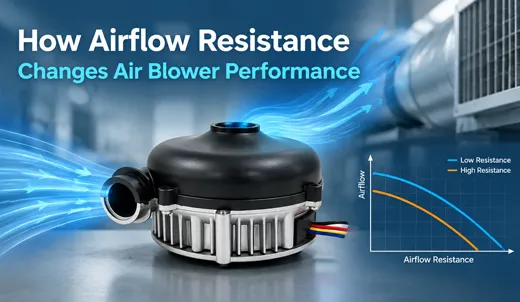
Selection should be based on the AR glasses' heat generation power, internal airflow resistance, and permissible operating temperatures. For consumer-grade, low-load scenarios (generating 1–3W of heat), specifications featuring an air pressure of 15–30 Pa and an airflow of 0.2–0.5 CFM are recommended. For industrial-grade, high-load scenarios (generating 3–5W of heat), specifications with an air pressure of 30–50 Pa and an airflow of 0.5–0.8 CFM are preferred. Priority should be given to blowers with a relatively flat P-Q curve (Pressure-Airflow curve); this ensures effective adaptation to the high-resistance environment within the sealed cavity of AR glasses, thereby guaranteeing stable cooling efficiency even as airflow resistance fluctuates.
(II) Adapting to Spatial Constraints: Prioritizing Ultra-Thin, Miniature Dimensions
Selection should be guided by the physical dimensions of the AR glasses—specifically the thickness of the temples, the clearance within the frame, and the available space for internal modules. Priority is given to specifications with a thickness of ≤4.5 mm and overall dimensions of ≤20 × 20 mm. In cases where space is extremely limited, ultra-miniature blowers measuring as small as 18 × 18 × 4 mm can be selected. This ensures that the embedded blower does not increase the overall thickness or weight of the device, thereby facilitating a lightweight and slim design.
(III) Compatibility with Power Supply Systems: Prioritizing Low-Voltage, Low-Power Specifications
Selection should be based on the AR glasses' battery voltage (typically 3.7–5 V), battery capacity (200–500 mAh), and required battery life. Priority is given to specifications featuring a rated voltage of 5 V, an operating voltage range of 2–6 V, and a power consumption of ≤1 W. This ensures that the blower can be powered directly without the need for a voltage booster circuit, while limiting the impact on overall battery life to less than 10%. (IV) User Experience Assurance: Prioritizing Low-Noise and Low-Vibration Specifications
Based on the specific usage scenarios, noise sensitivity requirements, and comfort standards for AR glasses, priority is given to specifications featuring noise levels of ≤32 dBA, hydraulic bearings, and vibration-damping structures. This ensures the absence of abnormal noises or perceptible vibrations during wear, thereby enhancing the immersive user experience.
(V) Reliability Assurance: Prioritizing Long-Lifespan and Protective Specifications
Based on the operating environment, lifespan requirements, and maintenance cost considerations for AR glasses, priority is given to specifications featuring brushless motors, dual ball bearings (with a lifespan of ≥40,000 hours), flame-retardant and anti-static materials, and an IP54 dust- and water-resistance rating. These features ensure suitability for both daily use and demanding industrial environments, while simultaneously reducing post-sales maintenance costs.
V. Industry Development Trends: Low-Voltage Blowers Drive Upgraded AR Glasses Experiences
As AR technology rapidly advances toward greater lightweighting, higher performance, extended battery life, and universal scenario adaptability, low-voltage blowers—serving as core thermal management components—are poised to follow five major development trends: miniaturization, reduced power consumption, increased efficiency, intelligent integration, and customization. These trends will continue to drive significant upgrades in the user experience of AR glasses.
(I) Extreme Miniaturization: Enabling "Seamless-Fit" Wearability
In the future, low-voltage blowers will evolve toward ultra-compact dimensions (≤15×15×3 mm) and ultra-light weights (<5 g). By utilizing nanoscale materials and integrated manufacturing processes, their volume and weight will be further reduced to perfectly meet the core requirement of "seamless-fit wearability" in AR glasses—allowing users to wear the device without feeling its presence. They may even be embedded directly within the lens frames, achieving "zero spatial footprint."
(II) Further Reduced Power Consumption: Significantly Extended Battery Life
Driven by advancements in brushless motor technology and optimized aerodynamic designs, the power consumption of low-voltage blowers is projected to drop from the current 0.25–1 W range to 0.1–0.5 W. When combined with intelligent sleep technology (which automatically shuts down the blower during low-load periods), the energy drain on the battery is reduced to less than 5%. This enables AR glasses to achieve an ultra-long battery life of 8 to 12 hours, effectively eliminating user anxiety regarding battery endurance.
(III) Optimized Balance of Efficiency and Silence: An Upgraded User Experience
Through the adoption of bionic blade designs, magnetic levitation bearings, and active noise cancellation technologies, low-voltage blowers will achieve a dual breakthrough: high air pressure (50–80 Pa) and ultra-low noise levels (20–25 dBA). This translates to a thermal dissipation efficiency increase of over 50%, while noise levels approach the ambient silence threshold. By completely resolving the inherent conflict between thermal management efficiency and noise generation, these blowers will provide users with a truly immersive and distraction-free experience.
(IV) Intelligent Integration: Dynamic Control Across All Scenarios
Future low-voltage blowers will integrate temperature sensors, rotational speed feedback mechanisms, and AI control algorithms to enable intelligent, dynamic speed regulation across all usage scenarios. These systems will monitor chip temperatures, ambient temperatures, and device load states in real-time, automatically adjusting fan speed and air pressure to strike an optimal balance between thermal efficiency, power consumption, and noise levels. Furthermore, they will support wireless control and firmware updates, thereby meeting the evolving requirements for intelligent system upgrades within AR glasses. (V) Customized Services: Tailoring Solutions to Diverse Scenario Requirements
As the application scenarios for AR glasses become increasingly segmented—spanning consumer, industrial, medical, and educational sectors—manufacturers of low-operating-voltage blowers are poised to offer comprehensive, multi-dimensional customization services. These services allow for the precise tailoring of parameters such as dimensions, voltage, power consumption, air pressure, noise levels, control functions, and materials to meet the distinct requirements of various environments. By enabling AR glasses manufacturers to rapidly launch differentiated products, these customized solutions facilitate the swift capture of market share.
VI. Conclusion
As a core component for thermal management and airflow regulation in AR glasses, the low-operating-voltage blower leverages five key advantages—low-voltage compatibility, miniaturized integration, high-efficiency heat dissipation, silent operation with low power consumption, and high reliability. It effectively resolves the fundamental design conflicts inherent in AR glasses—namely, the simultaneous demands for a slim and lightweight profile, high performance, extended battery life, and low noise levels—thereby emerging as a pivotal force driving the enhancement of the AR glasses user experience. From consumer-grade daily entertainment to industrial-grade high-temperature operations, and extending to medical-grade precision surgery, low-operating-voltage blowers cover the entire spectrum of AR glasses applications. Through continuous technological iteration and performance optimization, these components will continue to accelerate the evolution of AR glasses toward a future characterized by "imperceptible wear, universal scenario adaptability, and an ultimate user experience."
Looking ahead, driven by continuous advancements in micro-manufacturing, brushless motor technology, and intelligent control systems, low-operating-voltage blowers are poised to achieve even greater breakthroughs across dimensions such as size, power consumption, efficiency, noise reduction, and intelligent functionality. These advancements will provide robust technical support for the widespread adoption and application of AR glasses, helping to seamlessly integrate AR technology into people's daily lives and professional workflows, and ushering in a new era of intelligent living where the virtual and real worlds converge.